Showing posts with label solar panel failure. Show all posts

Thursday, December 25, 2014

Maintaining My Solar Panels


On the back of my house facing almost dead south is a roof mounted 7.36 KW solar array originally consisting of 32 Sharp 230 watt solar photovoltaic panels and 32 Enphase micro-inverters. When I made my purchasing decision in 2009 Sharp had manufactured 25% of the solar PV panels installed at the time and had been in the business for over 40 years. But since 2009 has suffered crushing competition by less expensive manufacturers and exited the business. The Sharp panel sold in the United States was manufactured in their Memphis Tennessee plant, which met the intent for the “Buy American” provision in the stimulus bill which provided the funding for a renewable energy grant I obtained from Virginia.

When I purchased my solar panels I also choose the Enphase micro inverter system. Though this system was more expensive than a single power inverter, it does two things for which I was willing to pay. The first is that the power cables running down the side of my house, albeit inside a pipe, are 120 current instead of 240. The second advantage to the micro inverters is that the energy production of each individual panel can be checked on the internet. My installation web page allows me to see the current energy produced by each of my 32 panels every minute, every hour, daily, weekly, monthly and the cumulative total power output. After two months of checking several times a day, I only spot check the solar panel midday a couple times a month. The reason I chose Enphase was to be able to easily identify a problem with the system. Little did I know that barely three years after the installation I would be facing repair issues.

Almost two years ago one of my solar panels appeared to fail. The original installer had gone out of the solar business, without renewable energy rebates and a viable solar renewable energy certificate market, there was not enough business to sustain a solar installation operation in Virginia. In addition, there had been difficulty with the installation- it had failed the electrical inspection three times before finally passing. However, his local roofing business appears to be successful. It took us a while to connect, but he referred me to a Maryland and Washington DC based installer, Lighthouse Solar. During the year and a half that I struggled to identify the problem with my solar system that seemed to get worse with each repair they tried to make, the two franchisees of Lighthouse Solar that I worked with went out of business or moved on. During the months while I was attempting to have my solar system serviced a second panel then a third panel appeared to fail.


Lighthouse solar struggled working with Enphase and Sharp and replaced one solar panel, two Enphase inverters and moved two panels. This did not fix the problem or even relocate it, nonetheless they remained convinced that the problem with the system was a faulty solar panel or panels. However, to me it was becoming increasingly clear that the problem was not originating in the panels or the inverters. The only other element to the system was the wiring. I was fortunate that when Lighthouse Solar exited the business he arranged with ProspectSolar to install a second solar panel that he believed would fix my ever growing problems (by this time my Enphase system only had 29 inverters reporting). When the field Superintendent for ProspectSolar came out, he flipped out at what he saw.

He found that the inch and a half conduit containing the wires for the system had come apart exposing the wires inside. He also noted that the conduit was oversized for the installation and that wire nuts were used to make the connections which are not an adequate transition method. I am told that the solar industry standard is to transition using insulated terminal blocks rated for the voltage.


ProspectSolar also noted that the box mounted on the east side of the house was mounted at an angle and the original installation crew cut a C conduit body at the same angle of the box and glued it together. This would void all UL listing rating and is not an acceptable application. The box wasn’t necessary since there is an existing prefabricated fitting that makes the turn. Other observations that ProspectSolar made were:
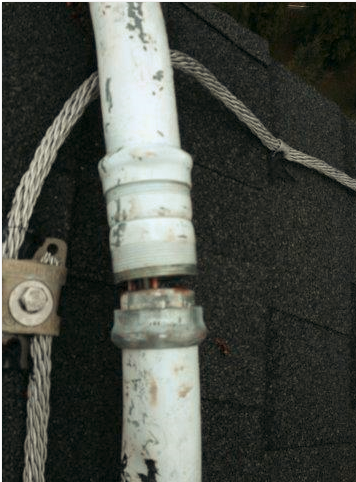


  • Most inverter companies call for rain tight fitting when pipe is exposed to the elements, my original contractor use standard fittings and wrapped them with duct seal.
  • The lay in ground lugs used to ground the system are only rated for one wire, to make  transitions the contractor should have used an irreversible crimp instead of putting multiple wires in the lug.
  • Racking companies make a flashing kit for the L-Feet, the L-Feet installed were screwed to the roof and caulked .However, my roof is not leaking and removing the solar panel racks is not advised at this time. 
  • A splice was made in the rail about a 8 inch section the piece was not long enough past the L-Foot so there is on a ¼ of the spice holding it together with 1 ½ self-tapper.
  • Instead of using the end clamps for the manufacturer to hold the panels down, the installer wedged the ground lugs in there to hold some of the top panels on and may be in danger of coming loose. 
ProspectSolar did not perform a full inspection but these observations were more than adequate for me to “get it.” The Solar panels were incorrectly wired and installed and it was probably faults in the wiring that were cause the panel and or inverter failure.

Prospect Solar would ultimately propose to perform the repairs on the system for $9.200. I contacted the original installer and sent him the notes and pictures that ProspectSolar had sent me. He surprised me and took full responsibility and found another subcontractor to correct his installation. Last week Jose arrived. Jose, and his crew had actually done the installation work on the solar system for the National Zoo Carousel. The system at the National Zoo is not much larger than my home system, but since he was working for PEPCO I hope he knows his stuff. Jose assessed the situation and explained to me that the electrical wiring is all wrong, many of the components are only rated for interior use and the system was not set up correctly.

At this point the plan is to remove all the solar panels, rewire the system and reinstall the solar panels. He estimates that once all the new parts arrive it will take about 5 clear and dry days. It’s December and almost Christmas. Jose has ordered his materials, the company I originally bought my solar system from is going to pay for the entire repair and reinstall of the solar PV system.

Wow, I was impressed by how honorably the original solar company has treated this problem. So, I am hoping for a mild couple of weeks at the end of January and that Jose is the guy who will finally fix all my problems. Since I am not paying him and he is merely a subcontractor, I do not control this process and cannot do a thorough vetting, but the truth is I could not even find someone to do a thorough inspection or even a repair without the assist from the original installer and Lighthouse solar. So, I will hope for the best, 

Thursday, October 17, 2013

Solar Panel Failure

My solar power output on a cloudy morning-note the failed panel
On the back of my house facing almost dead south is a roof mounted 7.36 KW solar array consisting of 32 Sharp 230 watt solar photovoltaic panels and 32 Enphase micro-inverters. We decided to go with Sharp Solar PV panels because when I made my purchasing decision in 2009 Sharp had manufactured 25% of the solar PV installed at the time and had been in the business for over 40 years. Sharp had continued to invest in the research and development of photovoltaic solar panels at that time, but since has suffered crushing competition by less expensive manufacturers. The Sharp panels put out almost 10% more wattage using the same square footage than many competitors and allowed me to fit the 7.36 kilowatt array on the main roof section avoiding any shadows from vents. The Sharp panel sold in the United States was manufactured in their Memphis Tennessee plant, which in 2009 had produced over a million panels.

The final point in their favor was the Sharp modules met the intent for the “Buy American” provision in the stimulus bill which provided the funding for a renewable energy grant I obtained from Virginia. When I purchased my solar panels I also choose the Enphase micro inverter system. Though this system was more expensive than a single power inverter, it does two things for which I was willing to pay. The first is that the power cables running down the side of my house, albeit inside a pipe, are 120 current instead of 240. The second advantage to the micro inverters is that the energy production of each individual panel can be checked on the internet.

I have gotten in the habit of checking my solar panels production numbers every month when I get my power bill. I am on net metering with NOVEC my power cooperative to sell my solar renewable energy certificates. I managed to register my system and get grandfathered into the Washington DC SREC market before it was closed to out of city systems. My installation web page allows me to see the current energy produced by each of my 32 panels every minute, every hour, daily, weekly, monthly and the cumulative total power output. After two months of checking several times a day, I only spot check the solar panel midday on the day when my power bill arrives or after storms to make sure all the panels are performing optimally. The reason I chose Enphase was to be able to easily identify a problem with the system. Little did I know that barely three years after the installation I would be facing repair issues.

Shortly before the New York Times reported emerging problems with some solar installations in a story about solar panels covering a vast warehouse roof in California failing less than three years into their expected 25-year life span, one of my solar panels appeared to fail. While I was attempting to have my solar system serviced a second panel appeared to fail. The company I hired to install the system was no longer in the solar business- without renewable energy rebates and a viable solar renewable energy certificate market, there was not enough business to sustain a solar installation operation in Virginia. They were focusing instead on energy audits, but they referred me to a Maryland and Washington DC based installer, Lighthouse Solar.

All solar PV panels degrade and slowly over time produce less power, however there appears to be a spreading of failures at two to three years. Solar photovoltaic panels have no moving parts so that the operating life of the solar panels is largely determined by the stability of the coating film, the quality of finish and fit of the panels and the proper sealing of the edging and connectors. Quality control in manufacturing is essential to have a solar panel that will last 25 years in sun, rain, sleet and snow.

The quality across the industry (and not just on my roof) has been brought into questing by the rising number of panel failures being reported in the media, though I could find no statistics. It is not just the less expensive Chinese solar arrays that are failing, the California warehouse failure reported in the New York Times reportedly has panels manufactured by an American Manufacturer. Solar panel power generation capacity grew from 83 Megawatts in 2003 to 7,300 Megawatts in 2012 with over 3,500 Megawatts installed in 2012 alone.

The quality and life span of these rapidly produced solar panels is about to be tested in the next few years. Also, without micro inverters a failure of one panel in an array like mine is a 3% reduction in power production and might not be noticed, it could be attributed to decreasing efficiency of the panels or weather variations. In Ed Begley, Jr.’s Guide To Sustainable Living, he said that over the years he had four solar panels fail, his storage batteries were replaced after 15 years and the wiring for the panels were damaged and needed to be replaced at 18 years. So, these systems are not trouble free even in sunny warm California, you cannot just install them and forget it.
Enphase trouble report
It took almost two months for me to identify another company and get them to come out. They looked into my system and spoke to Enphase and determined that the problem was probably the micro inverter so they ordered a new inverter from Enphase. By the time they had scheduled my repair a second inverter had failed and they were able to replace both inverters on the same day. According to the Solar Guys who prefer to remain nameless, they have replaced many Enphase inverters. The good news is that the inverters had a 10 year warrantee and it cost me nothing. The bad news is that the new inverters only fixed one of the two panels. After some back and forth between Enphase, Lighthouse Solar and me, I appear to have a solar panel failure also. Though I am on the back burner, Lighthouse is attempting to get a replacement Sharp solar panel and I hope before winter to have the panel replaced. Otherwise it will have to wait for spring. Since it is only a 3% decrease in power production, I will attempt to remain Zen about the timing and hope that Nick can locate a Sharp panel soon.