Showing posts with label sustainable water use. Show all posts

Wednesday, May 4, 2022

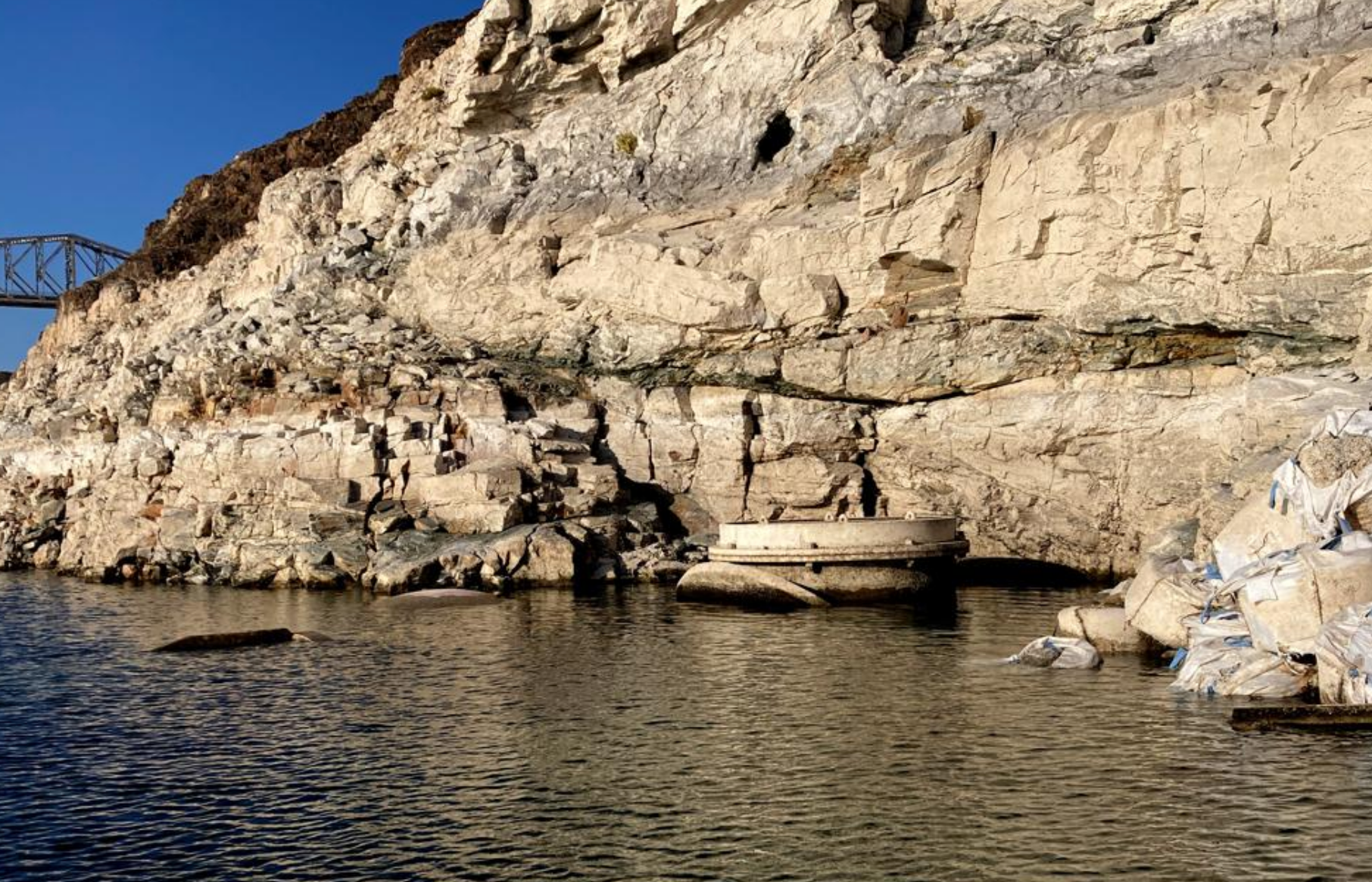
Lake Mead falls below First Water Intake


photo from SNWA 

The Southern Nevada Water Authority announced late last week that after 22 years of drought within the basin, the level of Lake Mead fell below 1,050 feet above sea level. Lake Mead drinking water Intake #1, the topmost pumping station is now above the surface level of the Colorado River reservoir behind Hoover Dam. The intake is the uppermost of three in the lake formed behind the Hoover Dam that provides Las Vegas with 90% of its drinking water supply. 

from Bureau of Reclamation

In their announcement the Southern Nevada Water Authority pointed out that its Low Lake Level Pumping Station #3 installed in anticipation of this happening is operational. Southern Nevada Water Authority constructed the third drinking water intake capable of drawing Colorado River water at lake Mead at elevations below 1,000 feet. Intake #3 ensures Southern Nevada’s access to its primary water supply as lake levels continue to decline due to the drought conditions. The problem is the level of lake Mead keeps falling and despite significant conservation efforts there is no longer enough water to supply the region. There is a time limit on how much longer there will be water.

There has been a drought in the Colorado River Basin for the past 22 years. This combined with higher temperatures has led to what some are calling aridification of the region. Lake Mead has seen more than 130-foot drop in the water level since the turn of the century. The annual flow of the Colorado River is estimated to have fallen about 20% in the 21st Century compared to the 20th Century due to both rising temperatures and drought. The region is in trouble.

from SNWA

The 1922 Colorado River Compact, negotiated by the seven basin states (Colorado, Nevada, Utah, New Mexico, Wyoming, Arizona, California) divided the Colorado River basin into upper and lower portions, allotted the Colorado River’s water on the basis of territory. The allocation of water rights based on territory allowed development to proceed in the lower basin (essentially California) while safeguarding supplies for the upper basin. Then, as now, California's growth and demand for water was viewed with concern by her neighbors.

The problem now is that the allocations promised under the Colorado Compact was based on an expectation that the river's average flow was 16.4 million acre feet per year  and ignored the needs of nature and the tribes. Subsequent studies: however, have concluded that the long-term average water flow of the Colorado is less. In addition, according to the University of Arizona, records going back to paleolithic times (more than 10,000 years ago) indicates periods of mega-droughts in the distant past. 

Now with more than twenty dry years, the reservoirs have dwindled to their lowest levels recorded. Allotted shares of water in the basin exceeds the average long-term (1906 through 2018) historical natural flow of under 16.0 million acre-feet. To date, the imbalance has been managed, and demands largely met by slowly using up the considerable amount of reservoir storage capacity in the Colorado River system-  Lake Powell and Lake Mead that once held approximately 60 million acre-feet (nearly 4 years of average natural flow of the river). It was assumed that drought years would be followed by wet year to refill the reservoirs. That has not happened recently, the last time the reservoirs filled was 1983. The basin is in its 22nd year of drought and the true existential crisis for Las Vegas looms just over the horizon. For without water there is no life.

Wednesday, September 15, 2021

Sustainable and Equitable Water

This past spring, the Virginia Department of Environmental Quality (DEQ) welcomed Renee Hoyos as director of the agency’s new environmental justice office. Ms Hoyos will direct efforts on the continued development – with community and stakeholder input – of the environmental justice program at DEQ. Recently, Ms Hoyos gave a Webinar “Water Equality: Sustainability and Access for All.” You can watch the recoding at Water Equity Sustainability and Accessibility for All - YouTube.

Our actions are making changes to our water environment and we need to consider the impact of our actions on all members of our communities. The minute you begin using a water resource you change its equilibrium and the local hydrology. Pumping groundwater often reduces discharge to streams and rivers.  Yet, historically water has been consumed in our region as an inexhaustible natural resource with little concern for costs, pollution, sustainability, purification , or transport of water. The availability of water is generally taken for granted, especially in our water-rich Commonwealth of Virginia. For generations water supply managers and local leaders have believed there is not a shortage of water, only a need to get the available water to where it is needed at low cost.

However, now, we have seen the results of the growth, irrigated agriculture, increasing population density, commercial and industrial development urban water sources have became the receptacles of sewage, urban and industrial runoff and wastes. Continued development is accompanied by increased waste discharges and more pollution from surface runoff. These are now threatening our Occoquan Reservoir and Potomac River. It all boils down to growing populations and economies lead to a continually increasing demand for what is after all a fixed resource: high quality water.

Environmental justice research documents disproportionate environmental burdens facing low-income communities and communities of color, ranging from landfills, industrial operations, to contaminated groundwater from agricultural activities due to shallow existing wells. Environmental justice contextualizes the environmental conditions that threaten the physical, social, economic, or environmental health and well-being of these communities within overall patterns of racism, classism, and other forms of discrimination. Water justice is one piece of the larger issue of environmental justice, but a foundation element of the problem.

Though, some communities feel environmental justice requires that water be free for low-income communities, but clean safe water is not free. First and most importantly the water utility imust maintain a source of water.  The  water can be supplied by surface water source such as a lake or river or from groundwater sources. These are precious resources, and without proper management of  surrounding and overlying land these water sources can be polluted. Water in its natural state can be unsafe for human consumption. It may contain naturally occurring bacteria, inorganic material and man-made contaminants such as pesticides and pollutants.

To make water safe for drinking, it must be treated. The water utility must filter and disinfect the water to remove impurities. Water treatment protects consumers from diseases like typhoid, hepatitis, and cholera, and remove harmful contaminants like nitrate, which can cause health problems. Finally, an adequate supply of water must reach homes and businesses via a water storage and distribution system. All this must be constantly maintained and improved. For those with access to public water supplies in Virginia we all have the same quality of water.

Lack of financial resources, however, often impacts private well and spring owners ability to provide clean, safe and reliable drinking water to their families. Just having the financial resources to maintain a safe drinking water from a private supply can be challenging. This is seen throughout Virginia. Residents in small rural communities after the surrounding areas develop find that their private wells and springs providing their drinking water supply experience diminished water quality and reliability. Cost to connect to the local water utility is often a problem with disadvantaged communities.  To plan and design a solution and identify funding options can be an insurmountable hurdle.  Planning to add low income housing to rural communities without public water and sewer connections simply piles challenges on theses residents that they do not have the financial resources to meet these challenges.


Under natural conditions…previous to the development of wells, aquifers are in a state of approximate equilibrium. Discharge by wells is thus a new discharge superimposed over a previously stable system, and it must be balanced by and increase in recharge of the aquifer, or by a decrease in the old natural discharge, or by a loss of storage in the aquifer, or by a combination of these.”

C.V. Theis, “Source of Water Derived from Wells: Essential Factors Controlling the Response of an Aquifer to Development, “  Civil Engineering 10(5) (1940): 277-80.

Monday, March 21, 2011

Water Politics- The Cost of Food In America and the California Water Supply


California Water Plan Update 2013's Public Advisory Committee meets on Wednesday, March 30, 2011. This meeting is open to the public. The future of California will be decided by the water necessary to maintain and grow the agricultural sector. The recent rains and favorable snowpack have alleviated the recent water crisis, but not the long term projections.

California water problems fundamentally result from having a growning economy and growing urban population in an arid climate. There is simply not enough water to go around. Almost all of the water in California comes from precipitation in the northern portion of the state and inflows from the Colorado and Klamath Rivers.

The solution to the problem is not increasing reservoirs. While water storage does allow flexibility, making it possible to carry water over to the dry season and to smooth out year-to-year variations in precipitation, it does not create water. Large reservoirs already exist on most major streams in California, limiting the potential to increase absolute water deliveries than in the past. There are no longer large unregulated amounts of water available to fill new reservoirs.

The current through-Delta system is unsustainable, but the solution suggested for a peripheral canal is limited in what it can accomplish. This canal alone will not fix the Delta nor create additional water supply. Nor is it likely (according to the US EPA) to improve native fish populations enough to allow immediate increases in exports above currently restricted levels. The idea of large construction projects is pushed by local interests that will profit from state subsidies. However, California no longer has the wealth to waste enriching a few and not solving its long term problems.

According to U.S. Department of Commerce, California’s GDP (gross domestic product) was slightly more than $1.8 trillion in 2007. GDP is the value of all goods and services produced in California. According to the U.S. Department of Agriculture, USDA, the total value of the agricultural output from the state’s farms and ranches was $36.6 billion in 2007, up from $31.8 billion the year before. This means that crop, meat and dairy sales account for about 2% of the state economy. However, when you count all the secondary economic impacts: wine making and sales, chesses making, olive oil production, juice making, food processing and packing this number grows to 7.9% of the California economy.

In terms of national agricultural output, $36.6 billion in revenue represents 12.8% of the U.S. total. The state accounted for 17.6 % of crops, and 7 % of the U.S. revenue for livestock and livestock products. California produces about half of U.S. grown fruits, nuts, and vegetables. Several of these crops are currently produced only in California.

The number of farms operating in California has been falling as farms consolidate and grow larger. There 75,000 farms and ranches in California. As a comparison there are approximately 1.9 million farms and ranches in the United States. However, California farms and ranches produced an average of $488,000 in revenue each year, compared to the average U.S. farm sales of $137,000. Yet, the average farm size in California was 349 acres, compared with the U.S. average of 449 acres.

According to Pacific Research Institute, agricultural crop volume production per unit of applied water (tons/acre-foot) increased by 38 % from 1980 to 2000. This increase in crop volume occurred during a period of falling food prices so that inflation-adjusted gross crop revenue per unit of applied water (dollars/acre-foot) increased by 11 percent by 2000 compared to 1980.

California has a complex, highly interconnected, and decentralized water system. Agriculture’s share of non-environmental water use was reported to be 77 % in 2005, down from an reported 90 % in 1960. As farmers have shifted to higher value horticultural and orchard crops, they have adopted more efficient irrigation technologies. There is still some progress that can be made in net water use by expanding implementation of drip irrigation and other technologies, but there are limitations, too.

The Central Valley Project (CVP), supplies water to thousands of Central Valley farms. The CVP water is subsidized and estimated yearly subsidy to farmers is roughly $60 million. This water subsidy was intended to subsidize the price of produce in the United States. Sixty million is a tiny fraction of the $36.6 billion that is the base cost of produce. The value of agricultural land in California is in part determined by eligibility for water subsidy and many of today’s farmers paid for this subsidy when they bought the land from the grantees. Maintaining this subsidy and the etrawealth it produces is what the farmers in the Central Valley are fighting for.

The Pacific Institute recommends the elimination of 1.3 million acres of drainage-impaired lands in the San Joaquin Valley from irrigation and agricultural use. This land represents less than 5% of the agricultural land in California, but would save 3.9 million acre-feet of water per year, while also reducing polluted surface water runoff and impacts to groundwater. This water savings represents 9% of the water used in California and is equal to two thirds of the total water used for urban residential use. This combined with limited conservation measures could solve the California water issues for decades.

However taking this proactive and ultimately necessary step is not likely to happen. The cost in terms of impacts on agricultural workers, agricultural communities, the value of the land and the wealth of the farmers will be fought tooth and nail by every political action group with an interest in the outcome. The urban residents of California elect just under two thirds of the state legislature. We can’t both use the water to subsidize the food and allow for growth in California. We need to choose between half of all U.S. grown fruits, nuts and vegetables and people. The cost of food in America is on a collision course with water supply in California.

Thursday, July 8, 2010

The Future of California

Unlike many communities in California, the Monterey Peninsula does not import water from the Sacramento Delta or Colorado River. Instead, in its semi-arid climate, the peninsula community is completely dependent on local rainfall for its water supply. The Carmel River has served as the main source for the Monterey Peninsula’s water supply since the first dam was built on the river in the late 1890s. Over 90% of the potable water supplied within the Seaside basin is delivered by California American Water (Cal-Am), a private company. Cal-Am operates several water distribution systems in the area, some of which are interconnected. The main system serves the Carmel Valley, Monterey Peninsula and coastal subareas of the Seaside basin. Presently, water is obtained from approximately 17 wells along the Carmel River and eight wells in the Seaside coastal subareas. The Carmel Valley wells extract groundwater from the Carmel Valley alluvium and operate year-round. Wells in the Seaside coastal subareas are used primarily in late spring, summer and fall- the dry season in California.

Cal-Am traditionally supplied its customers with water from wells located near the river in the Carmel Valley Aquifer. For a long time the water supplied was considered to be groundwater, which is not subject to State Water Resources Control Board (SWRCB) jurisdiction. However, in 1995, the SWRCB ruled that California American Water’s wells were diverting from the underflow of the Carmel River, thus making the diversion subject to SWRCB jurisdiction. Order 95-10 was issued, which held that California American Water had no valid permits for nearly 70 percent of the community’s water supply. Cal-Am went to court and nothing changed for a while.

Finally, in October of 2009 the SWRCB issued a Cease and Desist Order, CDO, for Cal-Am. The Order required Cal-Am to develop water supply sources in places other than the Carmel River. Cal-Am has not developed a substitute supply to date. The lack of a replacement supply was cited by the SWRCB as the reason the CDO was imposed. Initially, the order was put aside while the case was adjudicating, but has been reinstated by the court.

Though the CDO is directed against Cal-Am, the Monterey Peninsula Water Management District, MPWMD has been actively involved in the CDO because 95% of the people who live within MPWMD boundaries are Cal-Am customers. The MPWMD Board of Directors has consistently opposed the CDO due to technical flaws and the potential for adverse health and safety impacts to the community. MPWMD staff provided expert testimony in hearings on the draft CDO in Sacramento in 2008, and offered comments on earlier versions. When the final CDO was approved by the SWRCB in October 2009, MPWMD and Cal-Am filed suit jointly.

The MPWMD was created the California Legislature in 1977, and ratified by the voters of the Monterey Peninsula area in 1978. The District was formed in response to the drought of 1976-1977. The MPWMD Law provides authority for integrated management of the waters of the Carmel River and Seaside groundwater basin. The District’s integrated management responsibilities include control over water supply and demand, a combination which calls on the District to act both as a planning agency and a regulatory body, not as an advocate for unsustainable water use. In response to the SWRCB Order groundwater extraction near the coast increased markedly beginning in 1995, resulting in declining water levels and depletion of groundwater. After a series of studies in the early part of this decade it was estimated that the water being pumped from the groundwater basin was at approximately twice the sustainable yield of the Seaside basin. The Monterrey Peninsula was mining water at an alarming rate seemingly encouraged by the MPWMD

The state has ordered Cal Am to dramatically reduce its pumping of the Carmel River by 70 percent by 2016. Water conservation has been very effective in the region, but rationing may have to occur as the SWRCB steps down the water the Cal-Am may pump each year.

The Coastal Water Project is Cal-Am’s proposed solution to the Monterey Peninsula’s water supply shortage. The project consists of a seawater desalination plant and aquifer storage and recovery facilities. The project will replace water pumped from the Carmel River. Seawater desalination is used in 120 countries around the world for drinking water. As the technology has improved and costs have lessened, costal communities’ car looking to increase water supply from over-stressed rivers and aquifers.

Desalination is accomplished through a Reverse Osmosis (RO) process in which seawater is sent through highly pressurized, fine membrane filters that remove salt and other contaminants. What’s left is pure H20, which is why many bottled water companies use RO filters to produce their product. The project is based upon the recommendation by an independent team of environmental consultants selected by the California Public Utilities Commission (CPUC) of how to best meet the community’s water supply needs. After a series of public hearings and workshops, the Coastal Water Project was suggested as the best alternative to a long-debated new dam and reservoir on the Carmel River.

Cal-Am recently completed a 12-month study, which included operation of a pilot desalination plant at the Moss Landing Power Plant. The pilot plant functioned as a mini version of a seawater desalination plant, drawing 22,000 gallons of ocean water per day from the power plant’s cooling systems and testing a variety of membrane and treatment technologies to help refine design of a full-scale project. Desalinated water produced by the pilot plant was tested for more than 100 compounds in a water quality study that will be submitted to the Department of Public Health as part of the project permitting process. The data collected in this study will be valuable to the ultimate project, regardless of its location. It is estimated that the construction of the desalination plant will cost between $300 and $500 million which will be paid for by a doubling (or tripling) of water rates in the area.

Monday, August 31, 2009

Groundwater Use and Septic Recharge a Green Solution

It is a Common perception that Septic Systems are highly consumptive. However as studies by the USGS, North Carolina Division of Water Quality and the Dutchess County Water & Wastewater Authority have clearly shown, when designed for the correct densities and recharge rates, well (or even surface water) use combined with septic systems is highly sustainable and ecologically sound (Draper, 2006; USGS, 2002). Surface-water resources and groundwater treated in Septic onsite wastewater treatment systems are non-consumptive because they increase base flow into the watershed, and the water can be reused. Properly designed and managed traditional septic systems, alternative septic systems and clustered septic system are an effective method of waste disposal and trod lightly on the earth’s resources. According to the US EPA alternative septic systems, both single family and clustered, exceed the standards for sewage treatment plants and replenish existing groundwater systems, returning clean water to the earth’s water cycle. These alternative onsite systems can be more sustainable to the surrounding ecosystem than sewers and centralized waste treatment and are certainly less expensive for the homeowners in sparsely populated areas. However, the systems need to work properly and alternative systems with multiple tanks, compressors and various parts require consistent maintenance to continue working properly. Remember though, what goes into your septic system goes into the earth. Think carefully about the products you use to clean your house. Paint, solvents, gasoline, insecticides and poisons should never go down your drain. Every chemical you pour down your drain is buried in your yard. In a multitude of ways your yard is part of the earth’s yard.

The 2006 USGS study of water use and recharge in the Atlanta area (before the watering ban) found that average household indoor water use was 200 gallons per day and in the summer months the total water use increased to about 300 gallons per day including outdoor water use. Sustainability should be examined in light of that level of usage. The Dutchess County Water & Wastewater Authority commissioned a study by the Chazen Company at about the same time to better understand County-wide aquifer recharge rates and to provide guidance for setting sustainable development densities specifically related to the use of individual wells and conventional individual septic systems based upon average aquifer recharge. While the quantitative results of the study would apply to the soil types, rainfall and temperature ranges specific to the watershed studied, extrapolations can be made to nearby locations. The weather from New England to the Mid Atlantic to the South becomes warmer and wetter. Currently, average rainfall for New York is 39 inches per year while for Virginia it is more than 45 inches per year. The hydrologic soil groups present in New York are the same groups present in Virginia, but I would guess there is a higher concentration of C/D and D areas. The predominant area of the study, Wappinger Creek is C and C/D soil category. Chestnut Lick, a large creek, behind my house has similar soil hydrologic properties, but the soils on the acres surrounding the house contain a higher proportion of clay. This may be natural or due to the excavation associated with development of the lot and road.

Shallow groundwater flow, or groundwater runoff, intercepts the land surface, feeding springs, and creeks and seeping back into the surface waters as the perennial flow or streams, rivers and other freshwater bodies such as swamps, lakes and ponds. Deep groundwater flow also known as groundwater runout, does not intercept the land surface, flowing instead directly into the ocean. Of all the Earth’s water, only 3% is estimated to be freshwater. Groundwater is estimated to be more than 30% of the freshwater. Precipitation is the source of all groundwater, both shallow and deep. Hydrology is a young science and the modeling of the water cycle is not complete. The recharge rates and water cycle of the shallow groundwater in humid environments is much better modeled and understood than the deep earth sources of groundwater. So, while the entire water cycle is essential to man’s survival, only the shallow cycle will be discussed here.

Aquifer recharge consists of the portion of rain and snow (mostly rain in Virginia) that seeps through the soil to the saturated water zone, the aquifer. Another form of recharge is interflow which is infiltration water that flow along clay and bedrock layers, and roots to reach surface stream without entering the aquifer. Only the aquifer recharge supports wells and septic system dilution, while both recharge and interflow support the surface water supplies. In watersheds with high clay content in the soils a large portion of the rains is lost in runoff creating seasonal streams and high creek and river flow during the spring and fall rainy season. The average daily aquifer recharge (from rain and snow only excluding septic recycling) for Soils C, C/D and D in Prince William Virginia are estimated 326-583 gallons per acre. It is essential in a sustainable system that the groundwater level be maintained with recharge and adequate surface water is supplied to maintain the ecology even during drought years. My property totals more than 10 acres and our total indoor and outdoor household water usage was clocked during the early summer at between 100 and 150 gallons a day. We do not water our garden; trying to plant only what will thrive in the natural environment unaided. Virginia gets plenty of rainfall and it seems silly to plant anything that requires irrigation. Thus, not only is my septic system non-consumptive, the recharge rate vastly exceeds our water usage (and hopefully our neighbors since our water supply is dependent on total demand and recharge of the aquifer).

Though as demonstrated by the USGS studies, septic is a non-consumptive use of water, it is important that the septic system is designed and operated in a way that protects the environment. Whatever goes down the toilet or the drain goes into the earth. (See Septic Systems and the Ecologically Sustainable Life.)The Dutchess County report used nitrate concentrations at half the drinking water level as a proxy to achieve adequate dilution and natural attenuation of all contaminants. Historically, horizontal and vertical setbacks were developed without consideration of the dilution for wastewater components like nitrate, pharmaceutical residue, caffeine and other substances we humans consume, process or produce. The NY Department of Health separation distances were assumed (and these are almost identical to the Virginia setbacks), but the overall regional density of septic systems was examined to ensure that groundwater resources would not be overwhelmed by the total load of contaminants. The density recommendations were developed based on the nitrate concentration in traditional septic wastewater. Nitrate was used as a proxy because all humans produce about 10 pounds of nitrate per year, it does not easily break down and there is a drinking water standard. The target concentration was half the drinking water level to ensure all outcomes are safely below the standard since household size varies tremendously.

The Dutchess County study and the NC study found that overall average density of on-site waste disposal should not exceed one unit per 2-3 acres for an average size house to ensure water quality and recharge in groundwater supplies. The controlling factor in minimum lot size requirements in the northeast appears to be maintaining water quality, not groundwater recharge. Adequate dilution, soil filtration and time are necessary to ensure sustainable water quality. An interesting point is that it is not cost effective to install central water or waste disposal on parcels larger than about a half acre, since the cost of the piping (line connections) between parcels becomes much too high. Clustered or conservation subdivisions can be built, but need to maintain the overall density by maintaining open space. Those who live in dense population areas might want to look to the sustainable ideas of Adam Matthews and Siobhan O’Connor in Good magazine, the water issue, though, I find their idea of a composting toilet in any environment to be really scary from a public health perspective.