Wednesday, May 11, 2022

The Rules for Buying a Home with a Well

Virginia is a "buyer beware" state. Any well or groundwater problems not detected by the buyer during the sale process become the  buyer's problem upon closing the sale. There is no legal recourse back to the seller. These are the rules for buying house with a well to help you to avoid properties that are potential big problems before you close on a house.

  1. The house must have 2-3 acres of land.
  2. There must be a well completion report on file with the county health department that shows:
    1. The well stabilized yield should be greater than or equal to 6 gallons/minute
    2. The well should be drilled and more than 100 feet below grade (deep)
  3. The well should be a 6 inch diameter pipe with a bolted cap sticking at least a foot out of the ground
  4. Do not buy a home with a shared well
  5. The well was drilled after April 1, 1992 (under the current regulations).
  6. The well head must be at least 100 feet from the nearest edge of the septic drainfield and at least 50 feet from the nearest corner of the house.
  7. Health Department records show regular septic pump outs at least every 5 years. Annual inspections for alternative septic systems should be on file.
  8. Don’t buy a house with a well in Karst terrain.
  9. Test the well water for all the primary and secondary contaminants regulated under the safe drinking water act as well as pesticides. At the very least test the well water for Total coliform, E. coli, nitrate, lead, iron, pH, hardness, and residual chlorine.
    1. Don’t buy a house with a well that found E. Coli is present in the water or nitrate at more than three times background levels (of 2mg/L).
    2. Don’t buy a house that found lead present in a flushed sample.
    3. The well water must have a pH > 6.0
  10. Draw a glass of water from the cold tap in a bathroom sink and taste it. Don't buy a house with water you don't like. 

You need to make sure that the well is constructed properly and that the groundwater that is drawn into the home is safe to drink. Though there are many treatment options to fix contaminated water, you might not want to buy problematic water and some water problems can create a cascade of issues, so I have eliminated them. If you are buying a house, you need to make sure that you will have an adequate and safe water supply. This is not the same thing as strategies to live with diminished well yield or fixing your existing water quality problems. This is your one chance to make sure the water supply to the home is acceptable before you buy the home. There is no recourse after you buy the home.

Virginia Tech recommends that buyers should engage a licensed well contractor to assess the well and any treatment. As part of the assessment, the home buyer should obtain a copy and review with the licensed well professional the "Water Well Completion Report" and the septic system (or AOSS) repair/permit history and the history of septic tank pump-outs. This information is on file at the local health department. 

If you see more equipment than a blue pressure tank in the basement you need to know what water treatment equipment is being used, why it was installed and if it is working properly. It is not always obvious what a particular piece of equipment is just by looking at it because manufacturers tend to use the same casing style for all their products. You will need to test the water before the treatment equipment and after the equipment and determine if you can or want to live with the findings. There is a limit to the life cycle of any equipment and wells themselves. How old the equipment is can determine how effective it is and how long it will continue working.

For purchase I would recommend a broad stroke water test that looks at all the primary and secondary contaminants regulated under the safe drinking water act as well as pesticides. These kinds of tests exist. An example is the WaterCheck Deluxe plus pesticides test kit from National Testing Laboratories which is an EPA certified laboratory would work. There are others. Buying a package reduces the cost though the drawback is these packages are performed at a lower sensitivity level and WaterCheck was the most economical test I found. All the packages compare their results to the  US EPA’s Safe Drinking Water Act limits for the primary and secondary contaminants. Since there are no regulation for private well water, that is a reasonable standard to compare the water test results to. Be alert to anything that should not be in groundwater. The presence of low levels of man made contaminants may be an indication of a bigger problem.

There are no national standards for construction of private water wells, thought in recent decades more and more states have developed standards at least for construction. Wells are typically managed and regulated by the State or Local Health Districts, state departments of the environment or ecology. You need to know what the regulations are in your local area and when they were implemented. In Virginia the regulations went into effect in 1992. You want a well built to the current standards, but the truth is that the well may not last more than 30-40 years. Geology matters in how a well ages. Check water level and yield in an old well yield diminishes over time.

Most states require a permit to drill a well and well drillers to be licensed. Make sure you know what that means in your location. In Virginia that is a decent standard, but in Pennsylvania anyone with $60 can get a well driller license, there are no minimum training or knowledge required there. There are still a few locations where a shallow dug well does not require a permit or license. Know these things when you go looking for a house with a well.


Sunday, May 8, 2022

Oysters in Virginia


Oysters are the Chesapeake Bay's best natural filters. A single adult oyster can filter up to 50 gallons of water a day. Oysters also provide essential habitat for fish and other Bay creatures. The eastern oyster is one of the most iconic species in the Chesapeake Bay. For more than a century, oysters  made up one of the region’s most valuable commercial fisheries, and the oysters which are filter-feeders continues to clean our waters and offer food and habitat to other animals.

In the 1850s, more than 150 million oysters were harvested from the Bay each year; three decades later, this number jumped to 2,000 million. At the turn of the twentieth century, the Bay’s oyster fishery was one of the most important in the United States. However over-harvesting led to the demise of the Bay’s healthy reefs. Over the decades the reefs were scraped away by dredging, oyster beds were reduced to flat, thin layers of dead shell and live oysters spread over the Bay’s bottom. These damaged habitats offer less surface area for reef-dwelling oysters to inhabit, and can be easily buried by sediment. The result has been that many wild populations of oysters are now considered “functionally extinct” because of severe habitat losses.

There is good news. The University of Virginia researchers, in partnership with The Nature Conservancy, have just published a 15-year study that demonstrates that restored reefs can match natural reef oyster populations in about six years and continue to hold strong thereafter. Oyster reefs in nature are built by the hinge-shelled mollusks. The reefs form along sand bars and muddy tidal flats, molding to contours at water’s edge and serving as a bulwark against erosion. As sea levels rise, so do the reefs – if they are healthy.

The researchers at University of Virginia found that at 16 sites in coastal Virginia, composed of 70 reefs, the researchers studied the Crassostrea virginica variety of oyster. This species better known as the Eastern oyster or the Atlantic oyster is vitally important to the seafood economy found on the Eastern Seaboard. 

Where the reefs were spared or have recovered, waters are clearer and cleaner. The oysters and bivalve mollusks, suck in surrounding water, consuming plankton and any silt and debris, then eject the water back out, free of impurities. The scientists note the oysters ability to mitigate the impact of fertilizer seepage. Oyster reefs also provide habitat for crabs and fish, supporting coastal fisheries. The study also found that these ecosystem benefits that restored reefs provide can catch up with the natural reefs within a decade—meaning cleaner and clearer water as well as habitat that supports coastal fisheries.

 “Our study shows that restoration can catalyze rapidrecovery of an imperiled coastal habitat and help reverse decades ofdegradation,” said the study’s lead author, Rachel Smith, a postdoctoralresearcher in the Department of Environmental Sciences at UVA.

Now, the Nature Conservancy and scientis are working to manage harvests, establish sanctuaries, overcome the effects of disease and restore reefs with aquaculture -hatchery-raised seed in an effort to bring back the oyster. In 2010, Maryland and Virginia embarked on a tributary-based restoration strategy that will build, seed and monitor reefs in several Maryland and Virginia waterways. This commitment was incorporated into the Chesapeake Bay TMDL restoration plan. By 2015, six Chesapeake Ba tributaries had been selected for oyster restoration: Harris Creek and the Little Choptank and Tred Avon rivers in Maryland, and the Lafayette, Lynnhaven and Piankatank rivers in Virginia. Read more about thisprogram here.


Wednesday, May 4, 2022

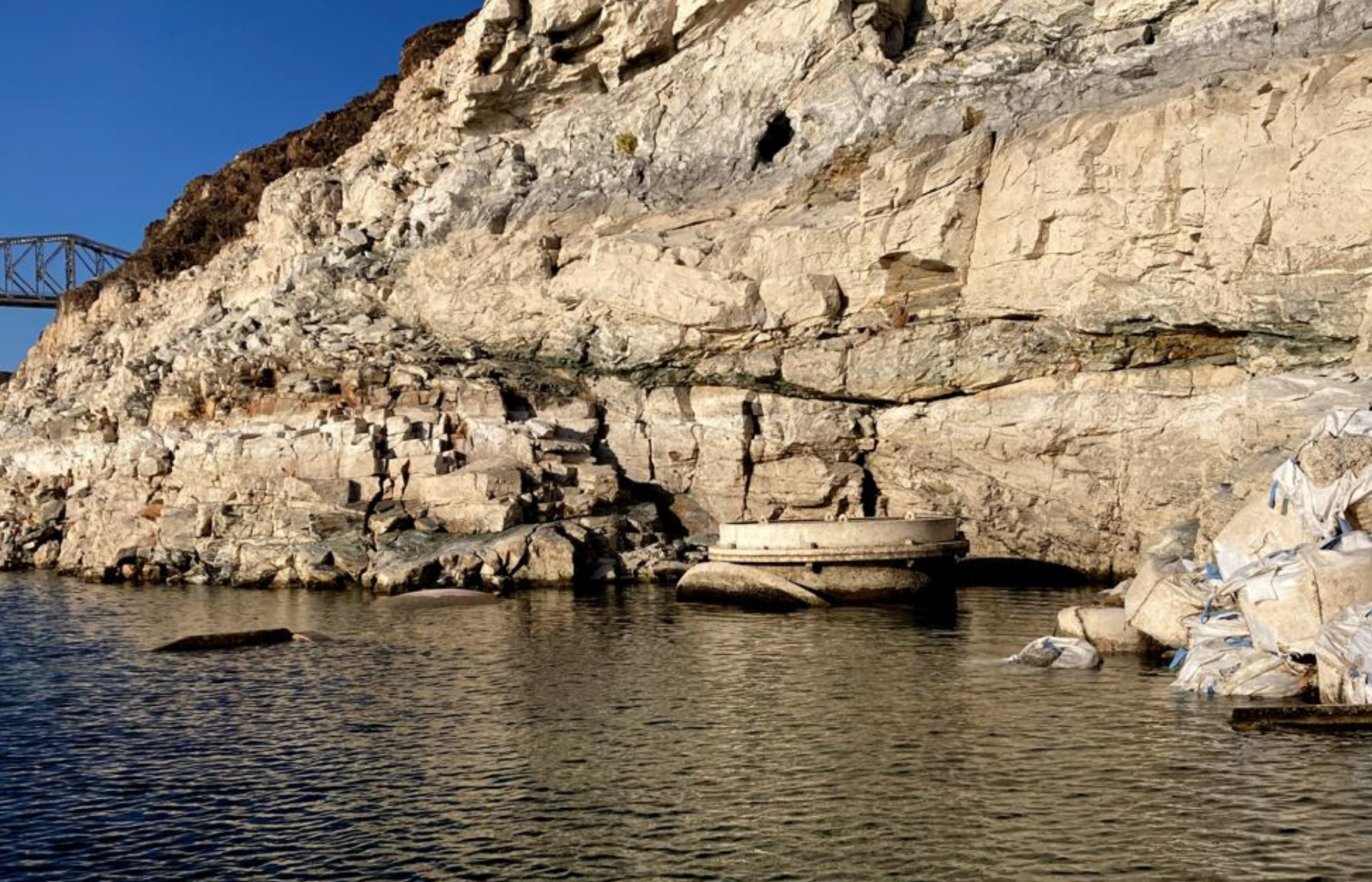
Lake Mead falls below First Water Intake


photo from SNWA 

The Southern Nevada Water Authority announced late last week that after 22 years of drought within the basin, the level of Lake Mead fell below 1,050 feet above sea level. Lake Mead drinking water Intake #1, the topmost pumping station is now above the surface level of the Colorado River reservoir behind Hoover Dam. The intake is the uppermost of three in the lake formed behind the Hoover Dam that provides Las Vegas with 90% of its drinking water supply. 

from Bureau of Reclamation

In their announcement the Southern Nevada Water Authority pointed out that its Low Lake Level Pumping Station #3 installed in anticipation of this happening is operational. Southern Nevada Water Authority constructed the third drinking water intake capable of drawing Colorado River water at lake Mead at elevations below 1,000 feet. Intake #3 ensures Southern Nevada’s access to its primary water supply as lake levels continue to decline due to the drought conditions. The problem is the level of lake Mead keeps falling and despite significant conservation efforts there is no longer enough water to supply the region. There is a time limit on how much longer there will be water.

There has been a drought in the Colorado River Basin for the past 22 years. This combined with higher temperatures has led to what some are calling aridification of the region. Lake Mead has seen more than 130-foot drop in the water level since the turn of the century. The annual flow of the Colorado River is estimated to have fallen about 20% in the 21st Century compared to the 20th Century due to both rising temperatures and drought. The region is in trouble.

from SNWA

The 1922 Colorado River Compact, negotiated by the seven basin states (Colorado, Nevada, Utah, New Mexico, Wyoming, Arizona, California) divided the Colorado River basin into upper and lower portions, allotted the Colorado River’s water on the basis of territory. The allocation of water rights based on territory allowed development to proceed in the lower basin (essentially California) while safeguarding supplies for the upper basin. Then, as now, California's growth and demand for water was viewed with concern by her neighbors.

The problem now is that the allocations promised under the Colorado Compact was based on an expectation that the river's average flow was 16.4 million acre feet per year  and ignored the needs of nature and the tribes. Subsequent studies: however, have concluded that the long-term average water flow of the Colorado is less. In addition, according to the University of Arizona, records going back to paleolithic times (more than 10,000 years ago) indicates periods of mega-droughts in the distant past. 

Now with more than twenty dry years, the reservoirs have dwindled to their lowest levels recorded. Allotted shares of water in the basin exceeds the average long-term (1906 through 2018) historical natural flow of under 16.0 million acre-feet. To date, the imbalance has been managed, and demands largely met by slowly using up the considerable amount of reservoir storage capacity in the Colorado River system-  Lake Powell and Lake Mead that once held approximately 60 million acre-feet (nearly 4 years of average natural flow of the river). It was assumed that drought years would be followed by wet year to refill the reservoirs. That has not happened recently, the last time the reservoirs filled was 1983. The basin is in its 22nd year of drought and the true existential crisis for Las Vegas looms just over the horizon. For without water there is no life.

Sunday, May 1, 2022

Water and the Future of Prince William

There was a Town Hall meeting held at Battlefield High School on Thursday, April 28th 2022 about the changes planned in land us in the Comprehensive Plan Update and Amendments and what the impact will be on Prince William County. Below is my talk. 

image from PW Conservation Alliance

The Changes in land use proposed in the PW Digital Gateway CPA , and the 2040 Comprehensive Plan Update will effectively remove over 10,000 acres from forested, open and agricultural use and convert them to:  

  • Higher density Residential: 2,400 acres  
  • Village and Hamlet residential and commercial mixed: 1,500 acres
  • Data center/ industrial 4,200 acres
  • The remainder of the rural area will be up-zoned.

This massive rezoning will bring great wealth to the landowners- land that is worth $25,000-$50,000 would magically be worth up to $1,000,000 an acre (in the case of data centers), but these windfall profits threatens the drinking water supply for all of Prince William County and the entire Occoquan Watershed.


The Occoquan Watershed is the source of the groundwater that not only feeds the private and public water wells in Prince William, but also supports the rivers and streams that provide drinking water for much of northern Virginia.

The Occoquan Reservoir contains 8.5 billion gallons of water that provides 40% of the daily water supply for Fairfax Water which in turn supplies Prince William Service Authority and 350,000 residents of Prince William.

The Occoquan Watershed is 590 square miles that covers two thirds of Prince William County including the all-important headwaters of the Occoquan and Bull Run. The water in the reservoir is a reflection of its watershed, and the Occoquan watershed is the most urban watershed in the nation with Prince William planning to make it even more so.  


from U.S. EPA

Development in the Rural Crescent threatens the health of the Occoquan watershed and the very sustainability and affordability of the drinking water supply for Northern Virginia. When generally open rural area is developed stormwater runoff increases in quantity and velocity washing away stream banks, flooding roads and buildings carrying fertilizers, oil and grease, and road salt to the Occoquan Reservoir.

Increased development in the Bull Run and Occoquan watershed as outlined in the PW Digital Gateway CPA, the 2040 Comprehensive Plan Update will increase paved and compacted surfaces and runoff and decreased forested and agricultural land. The result will decrease groundwater recharge and increase salinity and chemical and sediment contamination in the watershed.


The salinity in the reservoir has been rising over time and is reaching a critical stage.  Increased population, industry and paved surfaces that need to be salted will only make it worse. The only way to remove salt from the drinking water supply is to invest billions of dollars (by increasing your water rates) in building and installing desalination equipment in the region’s water treatment plants which are not currently capable of removing salt from the source water. There is no other source of water to supply our area. The costs to add treatment lines at Fairfax Water and UOSA (because it supplies up to 40 million gallons of reclaimed water a day to the Occoquan Reservoir) to keep the Occoquan Potable is estimated to cost between $1 and $2 billion. This is a cost that will be borne by the water rate payers including the residents in Prince William County.


from ICPRB top sodium sources wet weather on top

Development in the watershed triggers a number of problems with storm water runoff as the primary driver, though wastewater from UOSA and septic sources also contribute to the deterioration of the water quality. The rising salt in the reservoir is primarily from watershed runoff during wet weather and reclaimed water from UOSA during dry weather.


Sodium concentration in the reclaimed water is higher than in outflow from the two watersheds right now and has increased. As you can see in the slide from the Occoquan Watershed Lab more than half the salt in the 40 million gallons of water a day from UOSA is of unknown source- it is suspected that blowdown from data centers’ cooling may be a significant source since that water is typically softened to protect the heat exchangers.


Prince William County did not even consider the impact of the proposed changes to the quality, availability and sustainability water supply as they are required to do under the Comprehensive Plan law. Before we do irreversible harm to the ecology and our regional drinking water supply, we need to look at what the impacts of planned changes will be to the water supply.

Fairfax Water has taken the unusual step to ask that Prince William County convene the Occoquan Basin Policy Board and oversee a Comprehensive Study of the proposed PW Digital Gateway CPA and the 2040 Comprehensive Plan Update to evaluate their impact on water quality and quantity in the Occoquan Reservoir before any action is taken. The cost to restore the basin and treat the water is in the billions of dollars that will be borne by us, the residents who remain- not those who get the windfall from the sale of their land and dash off with their millions.


Wednesday, April 27, 2022

Prince William the NRCS Team Winner for 2021

The National resource Conservation Service (NRCS) has awarded our very own Prince William Soil and Water Conservation District's Water Quality Team the National Group Volunteer Award for 2021.  This award recognizes one outstanding Group nationally.  The award is presented to the most effective Earth Team in a conservation district.

Despite the challenges presented by the pandemic you cannot stop such enthusiastic volunteers. The Prince William Water Quality program was started in 2015 by Veronica Tangiri who continues to spearhead the four areas of the program today. The Water Quality program consists of four areas of effort that are designed to promote public awareness and natural resource protection:

  • Adopt a stream, pond or river
  • Chemical Water Quality Monitoring
  • River cleanups
  • Floatable Monitoring

In 2021 PW had 124 volunteers who provide over 300 hours to support the Chemical Monitoring programs. Also, during 2021 over 1,600 volunteers removed over 35,000 pounds of trash from the rivers and streams in the county- saving the county more than $140,000 it would have cost to hire staff to do the work.

The Water Quality Team does an amazing job protecting the natural resources of Prince William and making our community more sustainable. Congratulations to the Water Quality Team!!!


Sunday, April 24, 2022

Earth Day Thoughts

Last Friday, April 22nd was Earth Day. Since its founding in 1970 Earth Day has evolved into an opportunity to spend a few hours outside with others cleaning up the trash from our water ways and road ways, planting trees and nature walks in our many regional parks to appreciate the trees.

Trees are what I want to talk about. The trees act as natural pollution filters. Their canopies, trunks, roots, and associated soil filter polluted sediment from the runoff to our streams and creeks and ultimately to the Chesapeake Bay. Trees also use and recycle nitrogen and phosphorus which contribute to the decay of our Occoquan Watershed, the Potomac and the Chesapeake Bay and its estuary. Trees protect our watersheds and drinking water supply.

Once a tree reaches maturity, it sequesters 48 pounds of carbon dioxide per tree per year. Planting trees is one of the biggest and cheapest ways of taking CO2 out of the atmosphere to tackle the climate crisis. Not only do forests act as carbon sinks, but they also provide vital habitat for animals and ecological services for humans, such as purifying the air we breathe and regulating local temperatures.

Yet, as we look across Prince William County our tree stands and forested areas are being choked out by the effects of the emerald ash borer and invasive species. In addition, we continue to intentionally remove old growth trees to make way for highly developed land and low-density residential and now solar panels. (I would like to see the carbon impact analysis for removing forest to plant solar panels.)

Forest ecosystems are the largest terrestrial carbon sink on Earth, and their management has been recognized as a cost-effective strategy for mitigating greenhouse gas emissions, yet we have ignored planning and supporting the forested tree system in Prince William County. Nationally and locally several initiatives have been proposed to mitigate forest loss and climate change through tree planting as well as maintaining and restoring forest ecosystems. These initiatives been inspired by global assessments of tree and forest attributes and their contributions to offset carbon dioxide (CO2) emissions. 

Our neighbor, Loudoun County has funded a Reforestation program targeted at planting trees to permanently reforest currently non-wooded land in multi acre residential plots and community areas in HOAs. A proposal for a similar program failed to be incorporated into any version of the budget for Prince William County despite support from staff in Environmental Services Division. We would all benefit from tree planting and reforestation.  A well conceived planting program would bring improved water quality and quantity (both surface and groundwater), reduced soil erosion, increased wildlife habitat, shade, and of course the beauty of the trees themselves.


"In the United States, forestland represents nearly one-third of total land area and forests store more than three decades of carbon dioxide (CO2) emitted from economy-wide fossil fuels."

Wednesday, April 20, 2022

Maintaining My Well- Keeping Iron Bacteria at bay

Iron bacteria, while not a health hazard, are an incredibly common nuisance in water wells, and once you have it you will always have it. Iron bacteria use dissolved iron in the water as an energy source and leave slimy deposits of red iron hydrate as a by-product. I test my well water each year during the annual water clinic the Prince William Extension Office hosts and every few years for all primary and secondary pollutants under the safe drinking water act but, iron bacteria is not part of those suite of tests. The standard bacteria tests test for coliform and fecal bacteria and do not test for iron bacteria. However, about a decade ago I tested my well water for iron/reducing bacteria and found a significant level. There had appeared a number of symptoms that suggested its presence, so I looked.

Iron bacteria once introduced into the well will not get better. Instead continue to get worse ultimately binding up your pump and fouling the well. Iron bacteria can grow on pump intakes and screens openings causing plugging reducing the yield and efficiency of the well. In addition, the bacteria will make the water smell and taste vaguely unpleasant. A much earlier symptom is slime build up on the toilet tank flipper and in my case gross foam in the ATU tank.

Elevated levels of iron, manganese and sulfate in groundwater are an ideal media for iron bacteria to grow. Iron bacteria are present in soils and surface water in this area of Virginia and in many other parts of the country. Iron bacteria can be introduced into a well during drilling or repair. There are tests that can look for these micro-biologicals. National Testing Laboratories sells a mail in test for $69 plus shipping if you want to test your well. That is what I used.

It is common practice to regularly treat public supply wells to prevent biofilm buildup and mineral encrustation. Preventive maintenance is to chemically treat and flush the production well.  However, this has not been the practice in private water well, though now several state health departments and Canadian Provinces are recommending the regular chlorination of private wells to push back the iron bacteria.

The last time I heard Brad White a groundwater geologist from the Virginia Department of Environmental Quality Office of Ground Water Characterization give a talk on the work DEQ was doing in Fauquier County, he happened to mention that in every well he put a camera down he had observed iron bacteria.

From Penn State Extension: “As a water well ages, the rate at which water may be pumped tends to decrease.” Penn State attributes this decrease in performance of a well to incrustations and biofouling (with reducing bacteria) of well screens and rock fractures or borehole, saying: “In severe cases, the obstruction to flowing water can render the well useless. Major forms of incrustations can occur from build-up of calcium and magnesium salts, iron and manganese compounds, or plugging caused by slime producing iron bacteria or other similar organisms (bio-fouling).”

The Provincial Government of Alberta (Canada) says in describing iron bacteria: “This slime will coat the inside of the well casing, water piping and equipment, creating problems such as reduced well yield, restricted water flow and red staining of plumbing fixtures and laundry...” There are all sorts of odd problems that are caused by iron bacteria. Over time many wells develop these problems. These harmless bacteria can foul a well, damage pumps, stain plumbing fixtures, clog pipes, faucets, showerheads, and produce unpleasant tastes and odors in drinking water. Rarely is well water tested for iron bacteria. 

Private well owners typically try to treat the symptoms rather than the cause of the problem. Elimination of iron bacteria once a well is heavily infested can be difficult. Iron bacteria cannot be eliminated by most common water filtration methods or water softeners. Iron bacteria will foul that equipment.  However, though it is difficult to eliminate, it is actually very easy to control – just oxidize the heck out of the well. This is accomplished by chlorine shocking of the well with adequate chlorine concentration and several hours of mixing accomplished by recirculation.  

As recommended by Alberta, Pennsylvania and other states,  routine maintenance of a private water well should include regular chlorination to control biofouling of the well and maintain water quality. Personally, I chlorinate my own well on even number years (yes that includes this year) to prevent the buildup of a biofilm in my well and plumbing system and maintain the aesthetic quality of my water. I drain and flush the hot water heater annually to protect it from biofilm and mineral buildup and keep the temperature above 145 degrees to prevent the growth of reducing bacteria.  If you have treatment equipment like a water softener, you might want to consider chlorinating your well annually and treating your media to prevent a bio mat from forming in the media tanks.

There are so many things that regular chlorination will solve or prevent that you might want to consider it a regular part of home maintenance. Even if you do not chlorinate your well regularly, you should chlorinate your well when:

  • the well is new
  • the well has been repaired
  • the well has been flooded
  • the well exposed to bacterial contamination in another manner, such as a crack in the well cap  

In addition, you should test your well at a minimum for coliform bacteria each year, usually in the spring (or the wet season), and if there is any change in the taste, color or odor of your drinking water. A confirmed positive test for coliform bacteria requires disinfection at the least. I will not chlorinate my well until after I review the results of my recent well testing. The approach I would take to disinfect the well and plumbing systems is a little more involved (and inconvenient) than what I would do for iron bacteria alone.