Showing posts with label Dominion Energy. Show all posts

Wednesday, August 3, 2022

Dominion Adds Batteries to the Grid

from Dominion Energy

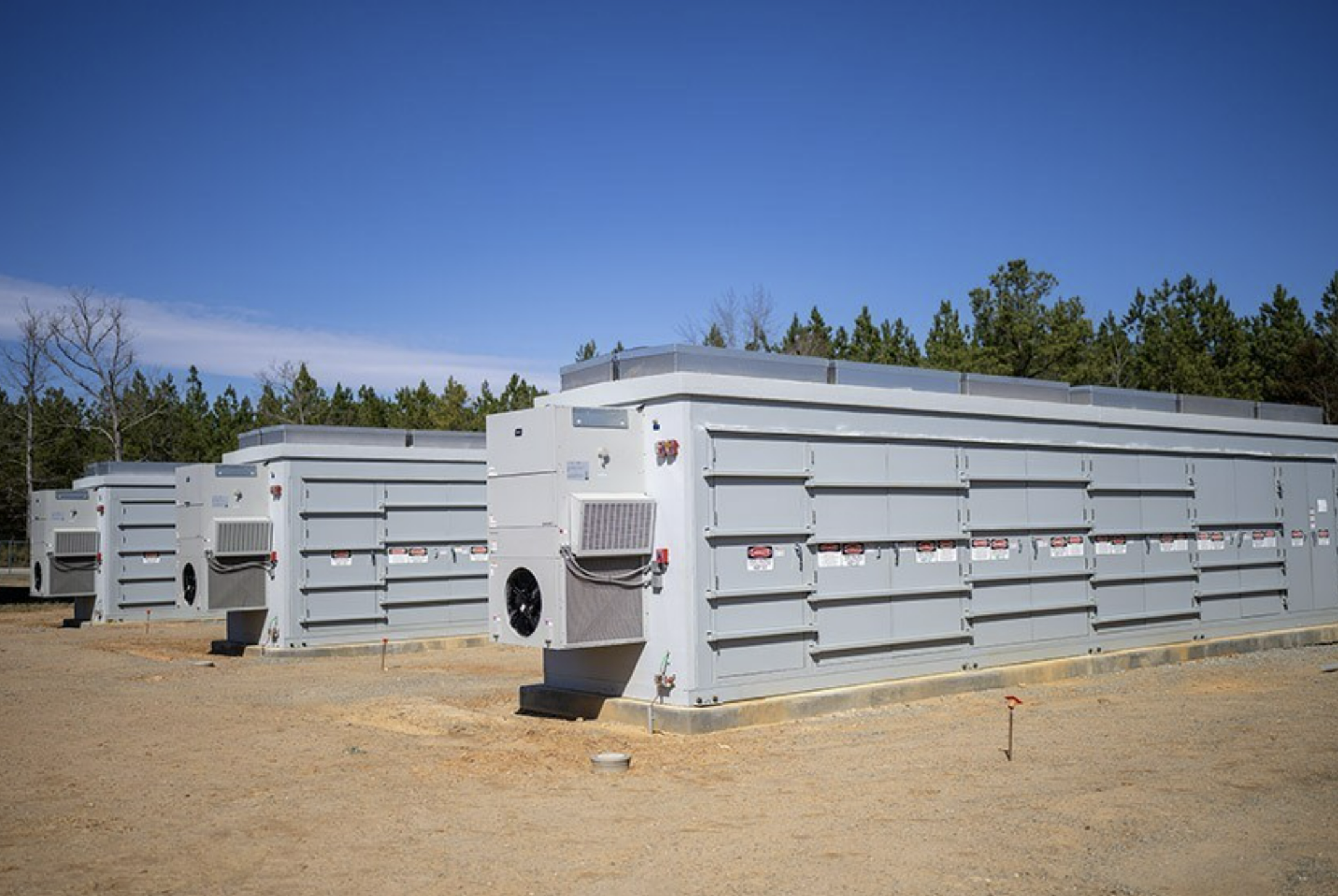
Last week Dominion Energy announced that it energized an independent battery systems totaling 12 megawatts at the Scott Solar facility in Powhatan County. "Battery storage is an integral component to the clean energy transition in Virginia, supporting grid reliability for our customers during periods of high demand and by helping to fill gaps due to the inherent intermittency of solar and wind power," said Ed Baine, president of Dominion Energy Virginia. "These battery systems will help us better understand how best to deploy utility scale batteries across our service territory to support our goal of net zero emissions by 2050."

Energy storage is key to grid reliability, continued solar and wind expansion, and achieving net zero emissions and more battery energy storage projects are under development by Dominion Energy. The company has two other battery storage pilot projects in its portfolio – a 2-megawatt battery in New Kent County that was commissioned in late February and a 2-megawatt battery in Hanover County that is scheduled to become operational later this year. All three projects were approved by the Virginia State Corporation Commission (SCC) in February 2020. 

The 12-megawatt battery at the Scott site can power 3,000 homes for up to four hours. The batteries are set up to charge and discharge daily. They are not designed as backup power, but are designed as supplemental power during periods of short, high-demand. These pilot projects will allow Dominion Energy to learn how to balance a grid using batteries and intermittent net zero generation.

Sunday, July 31, 2022

Overdrawn at the Energy Bank

Loudoun County has courted data and cloud companies and making development and land use decisions that has resulted in Loudoun County having the highest concentration of data centers in the world. These data centers provide a very significant amount of revenue to the county through real estate and business personal property taxes. 

The computer equipment in the existing data centers provides significant personal property tax revenues to the County’s budget. However, the value of those assets depreciates each year. Unless that equipment is constantly replaced the revenue will diminish over time.

In recent years, Prince William County has copied Loudoun County’s approach and undercut Loudoun County’s rate for the data centers of the personal property taxes on the computer servers. Data center growth in Prince William County has increased significantly and is poised to take off.  The proposed PW Digital Gateway is large enough to accommodate 33.4 million square feet of data centers. Which exceeds that data center square feet currently existing in Loudoun County.

Now, Dominion Energy has informed Loudoun County that it will not be able to provide power to new data center projects in Ashburn at this time. They lack  adequate transmission capacity and building it could delay new data centers coming online by a year or more.

Dominion Energy is required to provide power to customers. They do not have the option. However, infrastructure has to be built to meet the demand.  According to the PMJ  Data Center Alley… is experiencing unprecedented load growth driven by increases in data center load that started in 2018 and is expected to continue growing post 2027.” From 2018 to date, Dominion has had 44 requests to serve 2,050 MWs of load increase through the summer of 2025. These projects have to be integrated into the grid and so the PMJ, the regional transmission organization, has to be involved.

Once the PJM load forecast was updated, the system showed a need for reinforcements through additional source(s) to serve the load increase from the 500 and 230 kV transmission system nearby. PJM identified the need for additional transmission reinforcements in the area. Because the area is constrained on all 230 kV inlet transmission segments to serve the size of load and data center load has a flat profile throughout the day, power flow control or non-wires solutions can not solve the problem in this area. There is no work around. Dominion needs to run more 230 kV transmission wire, and the next fight will be about where they were going to route this power. The Data Centers required tower after tower of 500 and 230 kV  transmission wires.

After driving the 40% increase in power usage in Virginia the data centers have reached the limit of what Dominion Energy can supply on their existing infrastructure. I personally object to paying for the construction of infrastructure to supply the power to Data Centers. That expense is added to the Dominion cost basis and all our electric rates.  PMJ says will have to build more transmission for the data centers to assure system reliability. Using an old rule of thumb (that may be out of date), the current forecast looks like it will require about 25 more overhead lines to deliver the current projected power need. The data centers are turning Northern Virginia into New Jersey with the industrial blight of running power transmission lines to feed the data centers and massive industrial buildings. 

Though Dominion Energy has made significant investments in new infrastructure to meet the growing demand for electricity from the Data Center industry, it has not kept up with the surging growth of data center demand for power. According to Dominion Energy, "…the transmission constraints in a pocket of eastern Loudoun County that will impact new connections for large customers. This will not impact residential or small business customers." 

There has been some speculation that this development will benefit Prince William County data center development; however, looking at the transmission maps that Dominion has published for various public hearings it appears that that the same constraints will have to be addressed here. Also, the transmission lines will run through our communities. 


Historic Prince William has posted 266 Pictures of Prince William County taken from a helicopter on Friday, March 29, 2019 between 2pm and 3pm.  Take a look at the county here

Thursday, January 15, 2015

Dominion Power Lines through the Rural Crescent

Fighting to protect the Rural Crescent and our way of life in Western Prince William County is a never ending battle. The latest threat: a new power line controversy has emerged. This time Dominion is proposing a 230 kilovolt double circuit transmission line that would start at an existing power facility southeast of the Interstate 66-Prince William County Parkway intersection in Gainesville and go west 6 miles before turning north, and traveling west of route 15 and cutting a path through the rural crescent for about 12 miles or so. The proposed transmission line would be run on steel poles, with an average height of 110 feet, and require 100-120 foot wide path for the right of way, according to information available from Dominion Power. A Town Hall meeting at Battlefield High School on Monday evening drew about a thousand people. 

The community is up in arms about running the above adding this level of infrastructure in the form of ground transmission lines through the bucolic Rural Crescent. This will not only damage the beauty and integrity of the Rural Crescent, but we will have to pay for the infrastructure in our monthly power bills. According to the Prince William County Planning website, these power lines are for a data center at 15505 John Marshall Highway in Haymarket called "Midwood Center" and it is rumored to be built for Amazon. Data centers are the massive banks of computer servers that hold the internet together. Data centers create and operate the “cloud,” specifically, Amazon and others lease computing capacity. These facilities are primarily powered from the grid, but generators and batteries are always necessary to provide backup power if the grid goes down.

Though we do not generally think of it that way, a data center is an industrial use, not a commercial use in its need for square footage and power with a very large carbon footprint, diesel generators and fuel storage tanks. The grass roots group Protect PWC should not only be concerned about the appearance of the power towers, they should also be concerned about what this will ultimately do to our power costs. We all get to pay for the infrastructure in our monthly electric bills. Data centers may be industrial in their energy and environmental footprint, but they employ very few people and pay only limited taxes.

Amazon already runs data centers in Northern Virginia. Reportedly there are eight. In Manassas alone Amazon has two data centers that are run out of three buildings that look like large warehouses with green, corrugated sides. Air ducts big enough to accommodate industrial cooling systems run along the rooftops; large diesel generators sit in rows around the outside to ensure an uninterrupted power supply and internet. In 2010, Amazon was fined hundreds of thousands of dollars by the Virginia Department of Environmental Quality for installing and operating diesel generators without the required permits. Great, so they are not even good neighbors.

Data centers, by design, consume vast amounts of energy. According to the New York Times data centers are typically run at maximum capacity around the clock, whatever the demand, so capacity is always available. As a result, data centers can waste the majority of the electricity they pull off the grid. The New York Times had the consulting firm McKinsey analyze energy use by data centers and found that, on average, they were using only 6 - 12 % of the electricity powering their servers to perform computations. The rest was essentially used to keep servers idling and ready in case of a surge in activity that could slow or crash their systems.

In 2013 data centers used 2.25% of the power generated in the United States, and data center power use is reportedly growing at 20% a year and expected to reach 153 billion kilowatt hours in 2020. Energy costs (and security) are the biggest decision factor in locating energy-hungry data centers. Virginia, with its low cost nuclear and coal powered electricity is an attractive location for a power hungry use. However, the arrival of the data centers combined with the new U.S. Environmental Protection Agency (EPA) regulations on electrical power plants, our cost of electricity will not be low for long.

In June 2014 EPA announced their Clean Power Plan; carbon emissions regulations for existing power plants. A state-specific compliance plan is due to the EPA for review and approval in June 2016. Virginia is currently at 1,438 lbs. of CO2 emitted per megawatt hour of electricity generated and we need to be at 991 lbs. of CO2 per megawatt hour in 2020 and 810 lbs. of CO2 per megawatt hour of electricity generated in 2030 to be in compliance with the EPA Clean Power Plan mandate. In the proposed regulations, 2012 is the actual baseline year chosen by the EPA to calculate the interim and final CO2 goals for each state. However, with Amazon building data centers that each use more power than thousands of homes, added since the base year, we will have to accommodate their demand in our plan.

The Virginia Department of Environmental Quality, the Virginia Department of Mines, Minerals and Energy, the State Corporation Commission, worked with a consulting team to determine whether Virginia could comply with the proposed EPA Clean Power Plan. They identified four scenarios that allowed Virginia to meet the 2020 goal of 991 lbs. of CO2 per megawatt hour. All four of the successful scenarios include major increases in the use of natural gas fueled electrical generation and a need for expansion of the existing natural gas pipeline network into the Commonwealth and reduction in coal generated capacity as well as significant increases in the amount of renewable energy in the power generation base.

Our existing coal fired power plants will have to be replaced. The simple truth is that coal emits 2,268 lbs. of CO2 per Megawatt hour while the natural gas fired turbines emits 903 lbs. of CO2 per Megawatt hour. As the EPA mandated cap in CO2 emissions assigned to us is forcing us to build new low CO2 power generation capacity, Amazon and other data centers reeves up the demand for electricity without creating more than a handful of jobs or significantly paying for the infrastructure necessary to provide that low CO2 electricity: the power lines, lower CO2 electrical generating capacity, the gas pipeline necessary to generate more power at lower CO2, the renewable no CO2 generation etc. Virginia gets to pay for that in increased power costs.
Monday, April 8, 2013

Air Pollution from Coal Fired Power Plants


On April 1, 2013 the U.S. Environmental Protection Agency (EPA) and the U.S. Department of Justice announced a settlement with Dominion Energy Corporation to pay $3.4 million civil penalty and spend $9.75 million on environmental mitigation and community projects and close a coal fired power plant in Indiana. Reducing air pollution from coal-fired power plants and reducing the number of coal fired power plants in the United States, is one of EPA’s National Enforcement Initiatives for 2011-2013.

In addition to the civil penalty and mitigation projects mentioned above Dominion Energy must install or upgrade pollution control technology on two coal fired power plants, and permanently retire their State Line plant. The pollution control upgrades will produce annual reductions at the Brayon Point and Kincaid plants of sulfur dioxide (SO2) and nitrogen oxides (NOx) emissions by 52,000 tons from 2010 levels. The retirement of the State Line plant will result in an additional reduction of 18,000 tons of SO2 and NOx. The State Line power plant was first put into operation in 1929 and overhauled over half a century ago. Dominion Energy decided to close the plant rather than upgrade the pollution control systems announcing that intent back in November 2010 and finally closing the plant on March 31, 2013.

The reason that sulfur dioxide and nitrogen oxides matter to the EPA (and the rest of us) is because reacting in the atmosphere with sunlight and water vapor they form fine particulate pollution. Particles created this way tend to be fine particles with diameters smaller than 2.5 microns, called PM 2.5, which are the most dangerous to human health because the small particulates lodge in the lungs which can have both immediate and long term health impacts.  Combustion engines and coal burning power plants are key contributors to PM2.5 particles, and according to the US EPA and World Health Organization, the smaller, finer pollutant particles measured by PM2.5 are especially dangerous for human health. Studies have shown that there is an increased risk of asthma, lung cancer, cardiovascular problems, birth defects and premature death from these particles smaller than 2.5 microns in diameter.

Coal fired power plant and other sources of pollution like refineries and cars and trucks emit both particulates and precursor pollutants that form particulates in the atmosphere. Air pollution will be significantly reduced in the immediate region of the Dominion power plants and because particulate pollution can travel significant distances downwind, air pollution will be reduced outside the immediate region. The State Line Plant which sits on Lake Michigan and supplied power into the Chicago market had 515 megawatt capacity. According to the Chicago Tribune, Illinois alone added 500 megawatts of wind power in 2010, under DOE subsidized projects. Elimination of the State Line Plant will reduce particulate pollution.

Currently, under the Clean Air Act the US EPA has established both annual and 24-hour PM2.5 air quality standards (as well as standards for other pollutants). The annual standard is 12 ug/m3 (an air quality index, AQI of 50). The 24-hr standard is 35ug/m3 (an AQI of 99). These standards were last revised in December 2012 when the annual standard was lowered from 15 to 12 ug/m3. EPA’s analysis found the new lower standard for the annual exposure will prevent almost 2,000 premature deaths each year in the United States.  According to EPA seven U.S. cities averaged particulate levels higher than the 15 ug/m3, the former standard: Bakersfield, CA; Hanford, CA; Los Angeles, CA; Visalia, CA; Fresno, CA; Pittsburgh, PA; and Phoenix, AZ. The American Lung Association in their latest report states that twenty cities have average year-round particle pollution above the new EPA air quality standard of 12 ug/m3 and most are in California. Though the California cities will remain in non-attainment in the near term, the other cities are anticipated to be able to meet the standard with the implementation of the new regulations for coal fired power plants and other recent EPA regulations which will result in the closing of several power plants and the upgrade of the pollution control systems of the others.

The United States particulate levels are a small fraction of the levels in the worst areas of the world-Beijing, New Delhi, Santiago (Chile), Mexico City, Ulaanbaatar (Mongolia), Cairo (Egypt), Chongqing (China), Guangzhou (China), Hong Kong, and Kabul (Afghanistan).   However, studies have shown that air currents over the Pacific are carrying elevated particulate levels into California presumably from China. Combined with their automobile density and use, California cities might have a difficult time meeting the new PM 2.5 standard despite their strict regulations.

The air pollution in Beijing, home to over 20 million people, can be seen as the smog that wraps the city’s apartment complexes and office buildings on many days. The US Embassy in Beijing has their own PM2.5 monitoring station atop their building and has been reporting via an open Embassy Twitter Feed hourly PM2.5 pollutiondata. The U.S. Embassy reported a series of readings beyond the scale of the equipment air quality index, AQI, (which goes to 500) in fall of 2010. Particulates levels soared to over 700 ug/m3 last June and reportedly had levels hit 1,000 ug/m3 this past winter which sparked emergency measures in the city. All these levels are beyond the AQI scale. 

Current air quality levels from the US Embassy are “moderate,” but as Edward Wong reported in the New York Times and others reported elsewhere data from the 2010 Global Burden of Disease Study found that over 3.2 million premature deaths in 2010 due to PM 2.5 particle air pollution worldwide. In East Asia (China and North Korea) PM 2.5 contributed to 1.2 million deaths in 2010, and in South Asia (including India, Pakistan, Bangladesh and Sri Lanka) it contributed to 712,000 deaths in 2010. These numbers are more than double the deaths estimated by the World Health Organization based on 2004 data when there were fewer coal fired power plants, industrial plants and cars in these areas. Air quality in the urban centers of the United States has improved from the early days of the 20th century when our nation was the factory of the world. While the   EPA’s regulations tighten and renewable energy subsidies increased to further improve ambient air quality and reduce carbon dioxide and pollutants released in the United States, the fast growing economies of Asia are spewing pollution (not only carbon dioxide) into earth’s atmosphere.