Showing posts with label solar PV panels. Show all posts

Thursday, December 25, 2014

Maintaining My Solar Panels


On the back of my house facing almost dead south is a roof mounted 7.36 KW solar array originally consisting of 32 Sharp 230 watt solar photovoltaic panels and 32 Enphase micro-inverters. When I made my purchasing decision in 2009 Sharp had manufactured 25% of the solar PV panels installed at the time and had been in the business for over 40 years. But since 2009 has suffered crushing competition by less expensive manufacturers and exited the business. The Sharp panel sold in the United States was manufactured in their Memphis Tennessee plant, which met the intent for the “Buy American” provision in the stimulus bill which provided the funding for a renewable energy grant I obtained from Virginia.

When I purchased my solar panels I also choose the Enphase micro inverter system. Though this system was more expensive than a single power inverter, it does two things for which I was willing to pay. The first is that the power cables running down the side of my house, albeit inside a pipe, are 120 current instead of 240. The second advantage to the micro inverters is that the energy production of each individual panel can be checked on the internet. My installation web page allows me to see the current energy produced by each of my 32 panels every minute, every hour, daily, weekly, monthly and the cumulative total power output. After two months of checking several times a day, I only spot check the solar panel midday a couple times a month. The reason I chose Enphase was to be able to easily identify a problem with the system. Little did I know that barely three years after the installation I would be facing repair issues.

Almost two years ago one of my solar panels appeared to fail. The original installer had gone out of the solar business, without renewable energy rebates and a viable solar renewable energy certificate market, there was not enough business to sustain a solar installation operation in Virginia. In addition, there had been difficulty with the installation- it had failed the electrical inspection three times before finally passing. However, his local roofing business appears to be successful. It took us a while to connect, but he referred me to a Maryland and Washington DC based installer, Lighthouse Solar. During the year and a half that I struggled to identify the problem with my solar system that seemed to get worse with each repair they tried to make, the two franchisees of Lighthouse Solar that I worked with went out of business or moved on. During the months while I was attempting to have my solar system serviced a second panel then a third panel appeared to fail.


Lighthouse solar struggled working with Enphase and Sharp and replaced one solar panel, two Enphase inverters and moved two panels. This did not fix the problem or even relocate it, nonetheless they remained convinced that the problem with the system was a faulty solar panel or panels. However, to me it was becoming increasingly clear that the problem was not originating in the panels or the inverters. The only other element to the system was the wiring. I was fortunate that when Lighthouse Solar exited the business he arranged with ProspectSolar to install a second solar panel that he believed would fix my ever growing problems (by this time my Enphase system only had 29 inverters reporting). When the field Superintendent for ProspectSolar came out, he flipped out at what he saw.

He found that the inch and a half conduit containing the wires for the system had come apart exposing the wires inside. He also noted that the conduit was oversized for the installation and that wire nuts were used to make the connections which are not an adequate transition method. I am told that the solar industry standard is to transition using insulated terminal blocks rated for the voltage.


ProspectSolar also noted that the box mounted on the east side of the house was mounted at an angle and the original installation crew cut a C conduit body at the same angle of the box and glued it together. This would void all UL listing rating and is not an acceptable application. The box wasn’t necessary since there is an existing prefabricated fitting that makes the turn. Other observations that ProspectSolar made were:
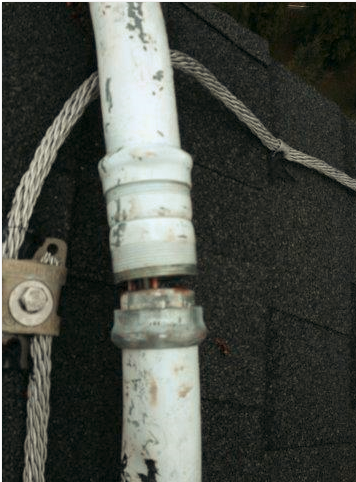


  • Most inverter companies call for rain tight fitting when pipe is exposed to the elements, my original contractor use standard fittings and wrapped them with duct seal.
  • The lay in ground lugs used to ground the system are only rated for one wire, to make  transitions the contractor should have used an irreversible crimp instead of putting multiple wires in the lug.
  • Racking companies make a flashing kit for the L-Feet, the L-Feet installed were screwed to the roof and caulked .However, my roof is not leaking and removing the solar panel racks is not advised at this time. 
  • A splice was made in the rail about a 8 inch section the piece was not long enough past the L-Foot so there is on a ¼ of the spice holding it together with 1 ½ self-tapper.
  • Instead of using the end clamps for the manufacturer to hold the panels down, the installer wedged the ground lugs in there to hold some of the top panels on and may be in danger of coming loose. 
ProspectSolar did not perform a full inspection but these observations were more than adequate for me to “get it.” The Solar panels were incorrectly wired and installed and it was probably faults in the wiring that were cause the panel and or inverter failure.

Prospect Solar would ultimately propose to perform the repairs on the system for $9.200. I contacted the original installer and sent him the notes and pictures that ProspectSolar had sent me. He surprised me and took full responsibility and found another subcontractor to correct his installation. Last week Jose arrived. Jose, and his crew had actually done the installation work on the solar system for the National Zoo Carousel. The system at the National Zoo is not much larger than my home system, but since he was working for PEPCO I hope he knows his stuff. Jose assessed the situation and explained to me that the electrical wiring is all wrong, many of the components are only rated for interior use and the system was not set up correctly.

At this point the plan is to remove all the solar panels, rewire the system and reinstall the solar panels. He estimates that once all the new parts arrive it will take about 5 clear and dry days. It’s December and almost Christmas. Jose has ordered his materials, the company I originally bought my solar system from is going to pay for the entire repair and reinstall of the solar PV system.

Wow, I was impressed by how honorably the original solar company has treated this problem. So, I am hoping for a mild couple of weeks at the end of January and that Jose is the guy who will finally fix all my problems. Since I am not paying him and he is merely a subcontractor, I do not control this process and cannot do a thorough vetting, but the truth is I could not even find someone to do a thorough inspection or even a repair without the assist from the original installer and Lighthouse solar. So, I will hope for the best, 

Monday, December 30, 2013

Solar Panels, SREC’s and Public Utilities

from WSSC
Last week in the Washington Post was an article by Katherine Shaver about the Washington Suburban Sanitary Commission’s (WSSC) solar farm. The WSSC plant in Montgomery County, Maryland has 8,500 solar photovoltaic panels covering 13 acres of land that began operations last fall and is expected to save the WSSC 25% of their electrical costs. They WSSC expects to save $3.5 million over 20 years without a single dollar outlay, while neighboring Fairfax Water found that even with today’s low solar photovoltaic panel prices that the solar project they considered would require 36 years of operation just to break even. How is that possible that two adjacent utilities have found such vastly different economics of solar photovoltaic installations? The answer is financial incentives provided by the state and paid for by the electric utilities and their rate payers.

Solar incentives exist in Maryland, but not Virginia. Some of the rebates are state wide, others are county incentives, there are rebates based on sales of SRECs which in turn are based on the power produced by the solar panels. A SREC is a credit for each megawatt hours of electricity that is produced, but used elsewhere. SRECs have value only because some states have solar set asides from their Renewable Portfolio Standards, RPS, which require that a portion of energy produced by a utility be produced by renewable power. Maryland has such a set aside. Maryland has a healthy and robust SREC market because they have both a significant solar carve out for solar that will be 0.35% of the RPS in 2014, a market that is open only to solar installations located in Maryland and a current $400 Solar Alternative Compliance Payment, SACP. The SACP is the amount that electric utilities, must pay per MWh of solar electricity that they are required to have, but are unable to generate themselves or buy rights to through SREC purchases to meet the state RPS solar requirement. In other words, the SACP is the maximum value of an in-state SREC. The minimum value is based on the supply. Right now Maryland has 153 MW of installed and registered in-state capacity with a 2013 requirement of 136.5 MW solar requirement under the RPS, but that requirement will jump to 194 MW in 2014 so the market will once more be under supplied and SREC value should approach the SACP price.

WSSC is engaged in a solar leasing contract with Washington Gas Energy Systems who actually paid the $12 million to install the solar panels on the WSSC land and will maintain and service the installation. The solar leasing companies are profit making enterprises that excel at managing, government guarantee loans, rebates, incentives, tax credits and SRECs, to maximize their profit while providing discounted electricity from renewable sources to landowners with favorably oriented roofs or large areas of open land in locations with adequate rebates. However, many of the solar panel leasing companies have enough scale to negotiate multiple year deals with utilities to buy their SRECs reducing their financial risk and ensuring a better deal than a small generator and eliminating market risk. They can in essence they can lock in a guaranteed annual profit for setting up the deal.

There are no RPS solar requirements in Virginia, thus no value to SRECs beyond the $10-$15 that a RPS credit is worth. Thus, Fairfax Water would have to pay about $12 million dollars today to save $14 million over 20 years in addition to incur the expenses to maintain the solar photovoltaic panels and borrow the money to buy the solar panels. This is not an expenditure that would be a good deal for their rate payers. If they paid just 3% interest on the money borrowed to install the solar panels then it would cost $21 million to save $14 million in electricity over 20 years. Lack of financial incentives for solar leasing companies is why Fairfax Water cannot “afford” to install a cool solar photovoltaic panel farm to power their water treatment and waste water treatment plants. However, Virginia electric rate payers have lower electricity costs than Maryland.

Washington’s DC Water has a different problem. The District of Columbia passed a law in 2011 which prevents out-of-state systems registered after January 31st 2011 from participating in the DC SREC Market. DC is currently the only under-supplied SREC market in the nation, because of the lack of large commercial solar farms and large industrial installations. Washington DC is a city with limited non-governmental buildings and no available private land. Approximately 288 MW of solar capacity is required under the Washington DC law by 2023. The 2013 RPS requirement is approximately 49 MW of solar power. Currently, there is only 28 MW registered, and Washington DC SREC prices are the highest of any SREC market at $480/SREC. Yet, despite the very rich SREC incentive in the District, construction of solar photovoltaic arrays has been slow. The leasing companies have been stymied by the lack of locations to install solar farms and building capacity one single family home and church at a time is simply slow going and requires a lot of overhead and sales staff. DC Water’s Blue Plaines Advanced Sewage Treatment Plant own much less buffer land than either Fairfax or WSSC, but is considering installing solar panels on the waste water treatment structures to allow them to reap the benefits of the SREC based solar savings.

I am watching these developments closely because due to a bit of luck, and the soul of an accountant, I registered my Virginia based solar photovoltaic array in the Washington DC market in July 2010 and I can sell my SRECs in the Washington DC market. The dollar value of the solar power I generate from my solar panels is worth less than half the money I have sold my SRECs for over the past three plus years. However, there is no guarantee that my SRECs will be worth anything next year and as more solar power is registered in DC the value of my SRECs will decrease. A nice big installation at DC Water or the Aqueduct properties could potentially eliminate the value of my SRECs.

Monday, May 20, 2013

Solar Panels Buy Now or Wait

The answer to that question depends on where you live, your cost of electricity, the orientation of your roof, and if you have to borrow the money to install the solar panels. However, the economics of solar panels with just the federal tax credit now make sense even in locations like Prince William County Virginia where there are no rebates or other subsidies beyond the federal tax credit. Above is a comparison of the costs and benefits of my solar panels compared to what that system would cost today.

There are several components to the cost and return of a solar system. The first cost is the cost of the system. The market cost of solar panels and installation has been falling for years. When I signed the contract to purchase my roof mounted solar system in 2009 (though it was not installed until May 2010) the cost per kilowatt for the Sharp panels I bought was about $6,700 plus permits and installation. These days that cost is about $1,800. I could probably have the same system that cost me $58,540 installed for around $19,000.That reduction in price goes a long way to make solar a reasonable purchase. Back in 2009 I was able to obtain a state rebate of $12,000 which is no longer available in Virginia. I also used the 30% federal tax credit which is still available. The net cost of the solar system in 2010 after rebates and tax credits was $32,578 today it would be about $13,300 for the same 7.36 kilowatt system.

To calculate the return on a solar photovoltaic system you need to know how much power the solar panels actually make. Now this is really weird, but with three years of data my solar panels make more power than predicted by the PV Watts model and the maximum output exceeds their rated power production. Instead of the expected 9 megawatts of power each year my solar panels have produced an average of 10.8 megawatts each year. This “bonus” was a pleasant surprise. I do not know whether it is due to having a steep angle roof that faces dead-on south over-looking a 3 acre open field or if the sharp solar panels are more efficient than rated. The dry weather in the past year might also have contributed to the higher than anticipated power production. Nonetheless, my solar panels make more electricity than predicted and that production rate would translate into a 9% return on investment (before depreciation) for solar panels bought today. It is not a spectacular return, but respectable and would justify installing solar panels and helping to reduce the summer peak demand on the power grid.
Lifetime power produced by my panels

However, with only the power generated by solar panels my return would around 4% before depreciation. To take the risk of buying and installing the solar photovoltaic system a chance for additional return on my investment was necessary. Solar Renewable Energy Certificates or SREC are another incentive that was available to me in 2010, but is no longer available for Virginia residents.

A SREC is a credit for each megawatt hours of electricity that is produced (and used by me). SRECs have value only because some states have solar set asides from their Renewable Portfolio Standards, RPS, which require that a portion of energy produced by a utility be produced by renewable power. Utilities in those states buy SRECs from solar installation producers. It is a way for states to ensure that the upfront cost of solar power is recovered from utility companies (and ultimately from the rate paying consumers). Most states at this point require their utilities to buy SRECs only from residents of their own states creating a closed market where the prices typically start off high until supply responds to that price. Other states, like Virginia, have no current solar RPS requirement and their RPS is voluntary. There are a couple of states, like Pennsylvania allow their utilities to buy their RPS from any resident within the PJM regional transmission organization. The Pennsylvania SREC price collapsed in early 2011 due essentially to oversupply and a method of calculating the penalty fee, the Solar Alternative Compliance Payment, SACP. It is to be noted that my electricity provider, NOVEC, would buy my SRECs for $15 each which is exactly what they pay for other forms of renewable energy they buy.

Within the PJM, a regional electricity transmission organization in 13 eastern states and the District of Columbia, I can sell my SRECs to utilities in Pennsylvania and Washington, DC (because I registered my system before the market was closed to outside systems). I had my solar system certified by both Pennsylvania and Washington though at the time only Pennsylvania was a viable SREC market. Today the Pennsylvania market has collapsed and in Washington DC my SRECs are worth around $400 for the moment. It will not last, all SREC markets get overbuilt in response to a high SREC value, but Washington DC has significant land constraints limiting large commercial solar arrays. So the SREC market may remain viable for a couple of years, I hope so, but I am not depending on it.

I had the choice to sell my solar renewable energy credits by estimate on the spot market or I can shop for a long-term SREC contract. The discount for a long term contract is huge and I refused to allow the company to put a lean on my house. A second option was a “guaranteed” price contract. In that case the fine print indicates that if the market collapses I might not have a viable guarantor of the payments. I would be giving up the upside without a true guarantee of price. The value of SRECs will go up and down depending on the supply and demand as determined by the number of solar installations, states requiring RPS, and states allowing sale within the PJM regional transmission organizations. RPS requirements are currently set to increase over time, but regulations and markets change. SRECs in Pennsylvania have ranged from $200-$300 per megawatt hour in 2010 and then collapsed and fell to $13 as the market remained open and became hugely overbuilt. Washington DC is currently undersupplied to meet the mandate so the SRECS have passed $400 each. The market will respond (I only hope not too quickly or too much). There was a time that New Jersey SRECS topped $670, they fell to $65 and are currently $140.

So while it lasts, the revenue from the sale of SRECs is higher than the value of the electricity the solar panels make. Today’s pricing make the return on investment in a solar photovoltaic system simpler to calculate here in Prince William County. There are other locations where various rebates and incentives and higher electricity rates make the return rich enough to support a market in financing alternatives, but it takes time and some level of expertise to optimize the solar incentives markets. Also, the incentives need to be paid for with either tax dollars (Department of Energy loan guarantees, grants and other incentives) or higher electricity rates- the renewable energy to fulfill the RPS and solar carve outs costs more than energy produced from other sources and results in higher electricity rates.