I am an engineer so I have a maintenance schedule for my home, but no home is immune to system failure, time and weather. Buildings and their systems have limited lives, and over time all systems fail; however, the late 2004 vintage house I bought in 2007 has experienced premature structural component failure. As the housing bubble heated up builders started throwing up houses and scrambling for construction workers. Inexperience and speed inevitably lead to quality control problems with the structure of my home (built by Patriot Homes a subsidiary of Lennar Homes)- over the years we have discovered insulation that was forgotten, attic vents that were not installed, a section of the floor plate that extended through the foundation, settling around the house, improperly installed flashing that lead to all sorts of leaks, concrete walks and steps that cracked and chipped in less than a decade and now a significant water infiltration problem due to a series of construction faults that has resulted in a serious potential structural problem.
Moisture and water infiltration is the major route of home destruction and needs to be addressed before your home is consumed by the elements and nature. Water stains can be caused by roof leaks, or condensing moisture. There's a lot of moisture generated inside homes. Bathrooms without exhaust fans or fans not vented to the exterior, leaking dryer vents, damp basements, kitchens and crawlspaces and basements can be the source of moisture in the in the home or attic. Improper roof ventilation or uneven insulation can create "cold spots" in summer or winter where moisture condenses to the point of dripping onto the ceiling or wet areas on the underside of the roof sheathing. Air conditioning equipment or heat exchangers in the attic can result in condensate dripping out of the system or off of the refrigerant lines or ducts. Water stains on a window sill and around the door were the first indications of my problem. Small water leaks of all kinds can be ignored for a long time, don’t. Though I made three previous attempts in the last few years to locate the source of the moisture, it took ripping off the framing around the front door to get even a hint of the extent of the problem.
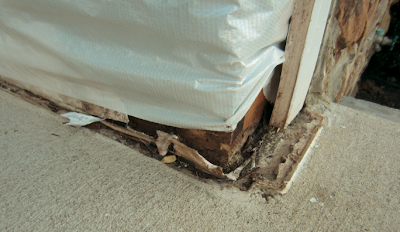

Before I am done it is going to cost me around $50,000 to rip the stone facing off my house, jack hammer the front steps, rebuild the support beams for the cantilevered floor that shields the front door, replace the headers for the door and the palladium window, correctly flash the new structure, extend the roof overhang, re-insulate the house, re-sheath the house (this time will concrete board) and replace the stone facing and rebuild the front steps. This all needs to be done before winter sets in. Failure to maintain a home or poor construction are not covered by homeowners insurance. Typically, this type of damage is not covered by insurance unless the water damage that caused the structural damage was caused by what insurance people call a covered peril such as a storm. There is no insurance coverage and I have no recourse against the former owner (Fremont Bank)- this is on my dime and I am cutting no corners in this project. The structural repair if done right will last a lifetime and appearance of the home will be improved (at least to my eye). It is fortunate that I just love a good construction project and that I have saved 2% of the cost of the house each year for repair and maintenance. The rule of thumb for home ownership has always been that 2-3% of a home’s value will be spent on average each year to maintain, repair and upgrade a home. A newer or well-maintained home can usually use the lower number.
The life expectancy of the components that make up a home depend on the quality of materials, the quality of installation, the level of maintenance, weather and climate conditions, and the intensity of use. Earthquakes, hurricanes, tornadoes, lightning and Derecho that do not appear to damage a home can stress components and shorten their life. Some components of a home have a shortened life expectancy due to intensive use and there are systems and components that become obsolete. In 2006 the National Association of Home Builders estimates that there were 124 million homes in the United States, with a median age of 32 years. Ten million of these homes were built between 2000 and 2006. Old age, poor maintenance and poor quality of initial construction are the usual causes of structural damage to homes. Water infiltration is the single largest underlying cause of structural damage.
Lennar Homes has an excellent check list on their website for regular and routine maintenance of your home. Home ownership requires maintaining your property. You can also read the National Association of Home Builders Study of Life Expectancy of Housing Components to estimate the life of all the components in a home and budget for replacement of things like hot water heaters which have an expected life of 10 years for gas and 11 years for electric and air conditioners with a life of 10-15 years or heat pumps with a life expectancy of 16 years. Be aware that all these items are likely to break and need to be repaired (repeatedly) in the second half of their life. I admit that last year I replaced my heat pump rather than repair it in order to improve the heating and cooling efficiency and comfort in my home. However, my current problem is about the structural integrity of the home. The framing and other structural systems were intended to last a lifetime and here I am rebuilding the front of the house.
Moisture and water infiltration is the major route of home destruction and needs to be addressed before your home is consumed by the elements and nature. Water stains can be caused by roof leaks, or condensing moisture. There's a lot of moisture generated inside homes. Bathrooms without exhaust fans or fans not vented to the exterior, leaking dryer vents, damp basements, kitchens and crawlspaces and basements can be the source of moisture in the in the home or attic. Improper roof ventilation or uneven insulation can create "cold spots" in summer or winter where moisture condenses to the point of dripping onto the ceiling or wet areas on the underside of the roof sheathing. Air conditioning equipment or heat exchangers in the attic can result in condensate dripping out of the system or off of the refrigerant lines or ducts. Water stains on a window sill and around the door were the first indications of my problem. Small water leaks of all kinds can be ignored for a long time, don’t. Though I made three previous attempts in the last few years to locate the source of the moisture, it took ripping off the framing around the front door to get even a hint of the extent of the problem.


Before I am done it is going to cost me around $50,000 to rip the stone facing off my house, jack hammer the front steps, rebuild the support beams for the cantilevered floor that shields the front door, replace the headers for the door and the palladium window, correctly flash the new structure, extend the roof overhang, re-insulate the house, re-sheath the house (this time will concrete board) and replace the stone facing and rebuild the front steps. This all needs to be done before winter sets in. Failure to maintain a home or poor construction are not covered by homeowners insurance. Typically, this type of damage is not covered by insurance unless the water damage that caused the structural damage was caused by what insurance people call a covered peril such as a storm. There is no insurance coverage and I have no recourse against the former owner (Fremont Bank)- this is on my dime and I am cutting no corners in this project. The structural repair if done right will last a lifetime and appearance of the home will be improved (at least to my eye). It is fortunate that I just love a good construction project and that I have saved 2% of the cost of the house each year for repair and maintenance. The rule of thumb for home ownership has always been that 2-3% of a home’s value will be spent on average each year to maintain, repair and upgrade a home. A newer or well-maintained home can usually use the lower number.
The life expectancy of the components that make up a home depend on the quality of materials, the quality of installation, the level of maintenance, weather and climate conditions, and the intensity of use. Earthquakes, hurricanes, tornadoes, lightning and Derecho that do not appear to damage a home can stress components and shorten their life. Some components of a home have a shortened life expectancy due to intensive use and there are systems and components that become obsolete. In 2006 the National Association of Home Builders estimates that there were 124 million homes in the United States, with a median age of 32 years. Ten million of these homes were built between 2000 and 2006. Old age, poor maintenance and poor quality of initial construction are the usual causes of structural damage to homes. Water infiltration is the single largest underlying cause of structural damage.
Lennar Homes has an excellent check list on their website for regular and routine maintenance of your home. Home ownership requires maintaining your property. You can also read the National Association of Home Builders Study of Life Expectancy of Housing Components to estimate the life of all the components in a home and budget for replacement of things like hot water heaters which have an expected life of 10 years for gas and 11 years for electric and air conditioners with a life of 10-15 years or heat pumps with a life expectancy of 16 years. Be aware that all these items are likely to break and need to be repaired (repeatedly) in the second half of their life. I admit that last year I replaced my heat pump rather than repair it in order to improve the heating and cooling efficiency and comfort in my home. However, my current problem is about the structural integrity of the home. The framing and other structural systems were intended to last a lifetime and here I am rebuilding the front of the house.

